Stephen C. Freidheim Symposium on Global Economics: The Global Jobs Challenge
Event date
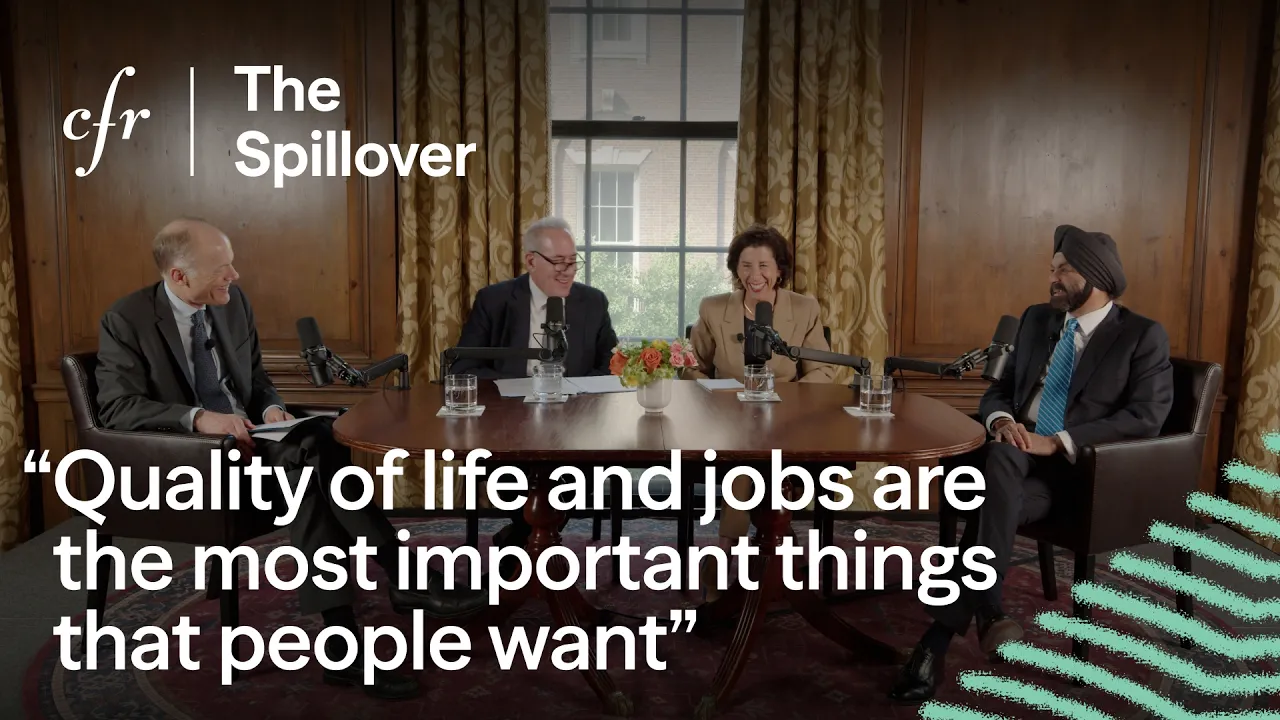
World Bank President Ajay Banga and former U.S. Commerce Secretary Gina Raimondo examine why jobs have moved to the top of the agenda in developed and developing economies alike—but for different reasons. In developing countries, the challenge is a coming demographic surge, with 1.2 billion young people entering the workforce and too few jobs waiting for them. In developed economies, the question is how artificial intelligence will disrupt work, reshape industries, and require workers and firms to adapt.
Together, they explore the future of work across these different contexts: how countries can capture the promise of AI and harness the energy of a young workforce to power the next wave of growth. The conversation will also examine the consequences if economies fall short—for opportunity, migration, and stability.
This discussion was taped as part of a podcast episode of The Spillover.
This symposium was established through the generous support of Council board member Stephen C. Freidheim and is presented by the Maurice R. Greenberg Center for Geoeconomics.
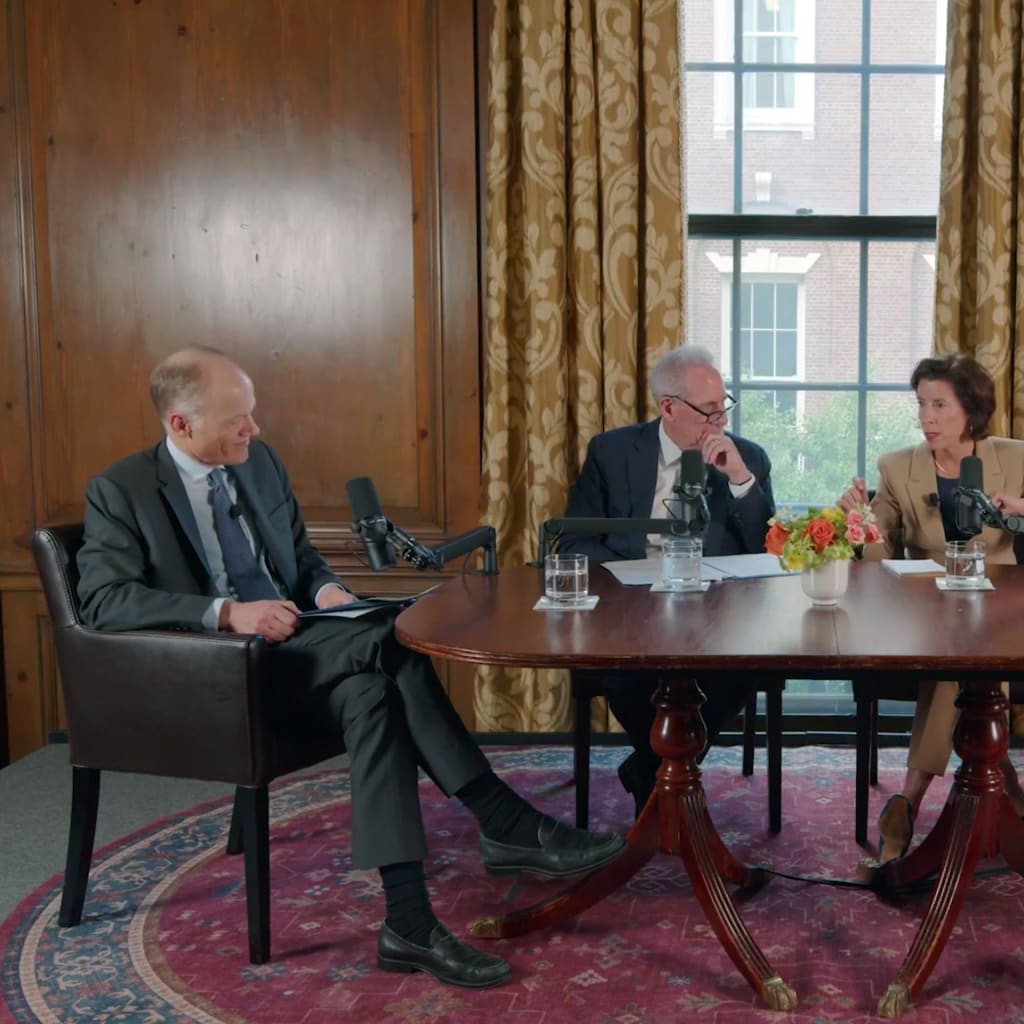
FROMAN: Well, welcome, everybody, to the Council. I’m Mike Froman, president of the Council. It’s great to have you here for a rather unusual event. We’re upstairs. This is not our usual table, our usual setup. But we’ve got incredible guests today.
This is the Freidheim Symposium, and we’re delighted and honored to have our two guests here today. This symposium was endowed by Steve Freidheim—who’s a member of our board, chairman of our investment committee, longstanding member, very active member—and has focused on broad issues affecting markets and the global economy. And over the years, everything from international economic policy to the future of economic leadership, post-pandemic economic recovery. We’ve had folks like Janet Yellen, Kristalina Georgieva, and Mark Carney. So we’re delighted to have the symposium here today, and are very grateful to Steve for his involvement and support.
This is a special taping of The Spillover, which is the Council’s newest podcast with a large and increasingly engaged audience. And we’re very excited about it, due in large part to one its co-host, Sebastian Mallaby, who is a senior fellow here in the Geoeconomic Center. And I’ll turn it over to Sebastian.
MALLABY: OK. So welcome to this special taping live of The Spillover. I’m your host, Sebastian Mallaby. We’re going to do this podcast from the Council on Foreign Relations office. And before we start, I want to give thanks basically first to—sorry—we’re going to give thanks to the Greenberg Center for Geoeconomic Studies, and to Steve Freidheim, who made this particular symposium possible. My co-host, Rebecca Patterson, can’t be here today; but luckily we have a distinguished substitute in the form of Michael Froman, the president of the Council.
And we have as our guest today Ajay Banga, the president of the World Bank, and Gina Raimondo, distinguished fellow here at CFR and former U.S. secretary of commerce. I don’t know how I made the cut, but I’ll borrow a line from JFK. Not since Thomas Jefferson dined alone has so much intellectual firepower being gathered around one table.
What we’re going to do today is about as preposterous as what I just said, which is to try and knit together two very different perspectives on one topic, which is the issue of job security. At the World Bank, Ajay Banga has been looking at this challenge from the perspective of development countries. Meanwhile, Gina Raimondo has been focused on the jobs challenge right here in the United States. So, Mike, why don’t you start us off with a couple of questions?
FROMAN: Well, Ajay, you’ve laid out an important strategic priority for the World Bank. You said, quote, “The best way to put a nail in the coffin of poverty is to give a person a job.” Talk about how you came to that view, what it means for that to be a priority for the Bank, when the Bank has had so many other priorities over its history, and how it’s affecting what the Bank does day to day.
BANGA: Yes. Normally it should be ladies first. That’s what my dad taught me. And you just changed the rules on me. (Laughter.) So here’s the gist of it, Mike. The gist of it is that the Bank’s mission hasn’t changed, it’s still elimination of poverty. The only point I’m trying to make is that if you start translating that into fractions, you start fragmenting the work of development. If you believe that every single thing is important eventually, it is. Quality of life and jobs are the two most important things that people want. But inside quality of life comes everything from clean air, to clean water, to education, to skilling, to health care, to commuting, to infrastructure. And if each of those becomes a pet cause, which then leads you in directions of fragmentation, the task gets really complicated.
When I try to step back and think about the young people in the emerging markets, you know, there’s a demographic logic that applies here. One-point-two billion young people in the emerging markets will become eighteen years of age in the coming fifteen years. Currently, those same markets are forecast to create 400 million jobs. Now, you know, those are forecasts made by economists, and as a recovering economist I pardon you for thinking we are all idiots—(laughter)—but the reality is that we may be wrong but we won’t be wrong by 800 million. And so whatever number you would like to put your number at, there is a big gap. And that gap is, to me, a national security, economic, societal challenge for us.
What looks like a demographic dividend in the emerging markets could become a demographic time bomb if you’re not careful. You will get—if you think illegal migration today is a problem, try and think this out with this bulge coming through in Europe, which will be exposed to Africa, which is where a great deal of the bulge will come from. Or try and think through societal challenges in the Burkina Faso, Mali, or Niger, three countries with military coups in the last three to four years. Take a look at the photographs, the twenty-year-old young men with a Kalashnikov had twenty bucks given to them by somebody who’s causing it and fomenting trouble.
So to me, this is mission critical. This is not a choice. This is not about—I’m not saying I’m going we’re going to do jobs and not do health care. You cannot do jobs without a healthy workforce. You cannot do jobs without education. You cannot do jobs without skilling. You cannot do jobs without, you know, clean air and clean water. This is not about choosing to do one and not the other. It’s about trying to find a way of stitching it together to care about the person.
A friend of mine once said to me that poverty—poverty is about two things, a state of being and a state of mind. The state of being you can fix with a handout. The state of mind you ain’t fixing with nothing, other than the opportunity and dignity of being a productive part of society. That’s what I mean about a job. I don’t mean working for a multinational corporation. It could be a smallholder, farmer. It could be an entrepreneur. It could be a large company, medium-sized company. I’m using the word loosely. But that’s the dignity, hope, opportunity that this could give you. And yet, allow you to do it the right way.
Build the infrastructure, both physical and human, care about governance, and corruption, and rule of law, and labor cost, and labor rules, and care about all those things. And also care about private capital mobilization, because that’s where jobs get created. Governments enable and private companies of all sizes and shapes create.
FROMAN: But if everything you just mentioned is a priority, then nothing’s a priority. How do you weave them together in such a way that it’s going to make progress towards that 800 million job gap?
BANGA: Exactly that way. Think about it differently. Look at it this way. Today, if you went to a minister of health in an African country, and you will find, well-meaning, everybody shows up saying I’m only going to fund purchases of medicines at a lower cost, because I can negotiate on your behalf. I’m only going to do vaccinations. I’m only going to do X, Y, Z. This minister is sitting there and saying, I need to provide universal health care, primary health care to my people. This Rubik’s Cube doesn’t fall into place.
What we can do for them is to say, let’s start with the objective of primary health care. How do you build that? You build clinics, both physical and digital. In the clinic, you put a nurse, a medical diagnostic technician, and a midwife. And now you start reaching people in the most remote places. With this, add simple technology—AI delivered at the edge, local compute—and you start making one primary health care center which is shared—you know, one doctor for ten of them. You start making them productive, connected to regional hospitals. You connect the right pyramid.
If you go to these countries and you talk to people, they’re all talking about building hospitals. Building a hospital is the most expensive way to solve for health care. You need them when you need them, but you don’t solve health care with that. So I’m actually arguing the opposite. I’m saying if you do it the right way, you actually stitch the disparate causes together, rather than—in that clinic, you will give vaccinations. In that clinic, you will do medical diagnostic tests. In that clinic you will find, you know, diseases earlier. You will find diabetes and heart attacks and strokes and all that earlier. But you won’t say, my only interest is vaccines, or my only interest is heart attacks, or my only interest is diabetes. That’s not what people want. People want the whole enchilada. They’re entitled to it.
MALLABY: Let me play devil’s advocate for a minute. So there has been a view over the years, people who’ve had your job in the past, people who’ve worked at the Bank, that the comparative advantage of the World Bank as a multilateral development organization, which spans a lot of different engineering, financial, governance skills, is—the sweet spot is big cross-border public goods, where you have to coordinate multiple countries. The big project, let’s say a dam or something, involves environmental impact, involves water engineering, lots of different skills. And that is what other institutions cannot do, because they don’t have your convening power at the Bank, and so forth. Your jobs agenda sounds more like country by country.
BANGA: It’s actually not.
MALLABY: OK.
BANGA: No, it’s not. So, for example, in the commitments we’ve made in basic infrastructure, first one said we will connect 300 million people in Africa to productive use of electricity. Not one light, one fan. That’s good. That’s humanitarian. We’re in the productive use of that electricity, so enough for them to open a business. As we count, we’re at fifty-five million and ready to go to up—trying to get to 300 million. And I have no idea if we’ll get there, but it’s double the pace of what we were doing before we set the goal. That’s not by country. That requires you, for example, to manufacture electricity at its cheapest location. Let’s take Mozambique. Mozambique is blessed with hydroelectric power, natural gas, and solar. South Africa needs that power. We’re doing this in Mozambique, connecting it with the regional electricity grid to South Africa. Have you noticed, South Africa’s blackouts have disappeared in the last two years? It’s not by coincidence. (Laughter.)
So if you start thinking about this carefully, it actually is exactly what you’re saying. The only difference is I’m not saying we won’t do the big hydroelectric dam in Rogun. We will. But I’m just saying I will not only do that. I will not only do global public goods that cut across countries. Like, I believe the real task—if the mission of the Bank was to eliminate poverty, how that got converted to global public goods that cut across countries beats the hell out of me. (Laughter.) I’m not in that space. And I don’t really care about what everybody else thought. I care about what I’m trying to do with the five years that I have a chance to make a difference. What I’m trying to do is focus our institution, full of outstanding people with great knowledge, on changing people’s lives through jobs.
MALLABY: Well, the key quality in a leader is to know where you’re leading, and you clearly do. So hats off to you. Gina, I’m going to move to you.
If Ajay’s reason to worry about jobs fundamentally is this demographic bulge coming through in the developing world, I think you have a different reason when you’re looking at this country, which is artificial intelligence. And you’ve said that economic development and workforce development have to go hand in hand. Now, I want to ask a question about how big you think this AI disruption is likely to be, because there’s a big range of estimates. If you talk to the leaders of the tech firms, they will say—you know, Dario Amodei says half of all entry-level jobs, gone in five years’ time. If you talk to some economists—in fact, we had some just a couple of hours ago here at the Council—the estimates I got out of them were kind of unemployment in three or four years will be four and a half percent, right? (Laughter.) So where do you stand on that spectrum?
RAIMONDO: Yeah. The answer is, no one knows. I really—I don’t know, and I don’t think anyone knows. I’ll tell you how I think about it. First of all, I do think about it in terms of a transition. I do believe that history tells us new technologies over time will lead to new jobs, new companies, new products, new ways of doing things. And I know, we’ve never had AGI and a technology quite like this. And I’m open to the possibility this will be different. I hear that. I don’t see—the data and everything I know about it hasn’t convinced me that this transition won’t be that different from others. So some number of years from now—I don’t know is it three, is it five, is it ten—I think you’ll see whole new AI companies. AI from—you know, created from whole cloth with
all kinds of different jobs that don’t exist now, including new jobs, new services, new products.
I mean, did you think that SpaceX would exist twenty years ago, and they’d actually have people doing that? Maybe you did. Lot of people didn’t. In fact—
MALLABY: Some people still think it shouldn’t exist.
RAIMONDO: Yeah, I was waiting for that too. (Laughter.) But I did not want to make that joke myself. Glad you did. But, you know, there’s something like more than half of all jobs that exist in today’s economy didn’t exist seventy years ago. So net-net, longer term, I am optimistic. And I say that as a policymaker, as an amateur economist, and as a mother of two kids, twenty-one and nineteen. I’m, you know, reasonably optimistic for them—very optimistic.
I am, however, quite worried about getting from here to there, and the disruption that we will experience, and how bad the—I view it as—like, I realize this is a podcast, I shouldn’t use my hands—but there’s going to be a trough. And I think we need—we, policymakers, CEOs, CFR, philanthropists, everyone—needs to be asking themselves, how do we make this trough as shallow as it can be, and bring forward the future? How do we get to the new jobs quicker? And how do we protect people? And I don’t think we’re nearly focused enough on that. And I don’t think the—I don’t think the answers are obvious. And so I think this country, probably at a governor level more than at a federal level, on a bipartisan basis, needs to get to work figuring out how are we going to ease this transition.
Because I’ll tell you this—and it’s not that different from what Ajay just said. I mean, you referenced the twenty-year-old kid who gets twenty bucks and a gun, is radicalized and excited to be, you know, in the military. That’s not unique to Africa, yeah? I mean, countries that have 25-30 percent unemployment rate of people in their twenties and thirties, that undoes a country. That undoes a democracy. And is that going to happen? I don’t know. But might it happen? Yes, if we’re not purposeful for a period of time. You know, I’ve talked a lot publicly about my own personal story, but during the so-called China shock, when so many manufacturing jobs left this country, my father lost his job. He was fifty-six. Never really got a good job again. It was very hard for our family. His constant refrain was: No one gave me a bridge to another chapter of work.
Now, I—people say to me, oh, what do you think of UBI? I really hate it. I hate it.
FROMAN: Universal basic income.
RAIMONDO: Yes, universal basic income. It’s exactly what you just said. Do you want a check to stay home, or do you want a job? Ask yourself this, when you—what makes an American an American? Yes, we care about freedom. Yes, we care about all of our freedoms. We are work-obsessed people. If you go in—if after this thing you go get a drink with a friend or something, and you meet a new friend at the pub, they ask you, what’s your name and what do you do for a living? That’s who we are. We work. We’re proud of it. Work is more than a paycheck. It’s dignity and its purpose.
So what’s my point? My point is, I don’t know what the unemployment rate will be. I don’t think we’re on a good path right now, because I think every incentive that a business has is to hit the layoff button and figure it out later. I think unemployment insurance was created a hundred years ago and isn’t going to get us through this transition. Unemployment insurance mostly doesn’t work for white-collar workers who make more than $70(000)-80,000 a year. I think we spend a trillion dollars a year on mostly ineffective job training programs and community colleges. We just—we’re just not set up to successfully get through a transition. And, by the way, we’ve really never successfully gotten through a transition without some period of, you know, job loss.
And I’m not saying—let’s say, for example, ten million people are laid off quickly, which is on the very low end of the estimates that, say, Dario—you reference Dario—would say.
MALLABY: Everything is low compared to Dario, but yeah.
RAIMONDO: Everything’s low. You know, I’ve seen everything from ten to fifty million jobs are AI-vulnerable. So pick a number. Ten million. You’re not going to see bread lines. I’m not going to say that’s going to be an epic recession with bread lines. You may see riots in the street. You may see a massive increase in political violence. You may see massive increase in violence towards business leaders, tech leaders, and some of—you know, policymakers.
MALLABY: And, for context, I think it’s right that ten million job loss would be five times the China shock in the early 2000s.
FROMAN: And that was over twelve years.
MALLABY: Yeah. Right.
RAIMONDO: I think maybe three—I think maybe three times the China—yeah. People can argue how many, but it’s multiple times the China shock.
MALLABY: Yeah.
RAIMONDO: Yes. And that was over a long period of time.
FROMAN: And that was over a longer period of time.
RAIMONDO: So my point is it doesn’t—it does not take a very high unemployment rate to fundamentally disrupt a country and its politics and its institutions, if the losers are concentrated and the winners are concentrated, there’s nothing to help the so-called losers transition, and it happens fast.
MALLABY: Even if you look at the polls today, the anticipation of job losses, which haven’t shown up in the data yet, is already changing politics.
RAIMONDO: Yeah. Correct. Yeah. Absolutely. And, by the way, it’s different than Africa. It’s different—like we’re the least optimistic country when it comes to AI.
Can I make one comment, which is not responsive to your questions and maybe not even appropriate, but that never stopped me before? (Laughter.)
MALLABY: There goes Gina. (Laughs.)
RAIMONDO: Yeah, there goes Gina. (Laughs.)
Listening to you talk about the kind of laundry list of things that you could do and then you become fragmented, reminds me of the Democratic Party. (Laughter.) And I have said this many, many times.
BANGA: That’s true.
RAIMONDO: Will you lose your 501(c)(3) status if I—this is my, Gina Raimondo’s, view, former elected official, not the view of the CFR. People say to me frequently, how come—what’s it going to take for Democrats to be more successful? And I feel the answer lies in a lot of what you just said. If we reduce ourselves to the party of the checklist—where are you on housing, where are you on immigration, where are you on climate, where are you on—buh, buh, buh—choice, buh, buh, buh, buh, bup—then you stand for nothing. You stand for being on the right side of a litmus test of a checklist. And I think you have to stand somewhere. And I think the place we need to stand is strongly on the side of good jobs for all Americans.
MALLABY: Secretary Raimondo, if you would like to declare your run for—
RAIMONDO: No, no. (Laughter.) That would definitely get me—
MALLABY: That would be fine with us.
FROMAN: And we get a lot of listeners to The Spillover, I think. This is the place to make announcements. (Laughter.)
Gina, let me follow—let me follow up on that, because you’ve laid out, you know, quite a picture of what could happen if we don’t get this right. But we—I don’t know how many meetings or conferences I’ve gone to where we get to this point in the conversation, everyone says we got to do something about, and then we move on and say, yeah, let’s meet again next week and talk about how we have to do something. So, you know, you’ve been out around the country. You’ve been a governor. You’ve been the secretary of commerce. You’ve seen a lot of pilots and projects, successes, you’ve seen other countries deal with similar issues in different ways. What do you think the—what’s the most promising policy? Should we have a new tax policy that really shifts the burden from labor to capital? Should it be about apprenticeship programs? Do you think the government has an answer to this, or should it all be private sector led?
RAIMONDO: Yeah, yeah. It’s an excellent—by the way, I think that’s well said, because I’m also in so many of these discussions. And, of course, you read the paper every day, and it’s a sky-is-falling hysteria, and almost no concrete ideas for solutions. I find it to be stunning, on the left or the right or anywhere in the middle. I would say a couple things. In some ways, I think we know what’s broken and has to be fixed. And in my experience, big things usually only happen in times of crisis. And I hope that AI is enough of an outside force that we get our act together and make the changes necessary before there’s a crisis. What am I talking about?
For a decade or more, many, many people, smart people, have been saying the college system in America mostly doesn’t work. We have thousands of colleges and universities. Forty percent of people who go don’t graduate. They wind up with debt. Many who graduate don’t—are underemployed and saddled with debt. And college hasn’t fundamentally—my daughter goes to a fantastic college. She’s being taught economics basically how I was taught thirty-five years ago. So people know how to fix that. It should be shorter. It should be less expensive. We should tear down the wall between school and work. Let’s get around to the business of doing it.
I referenced unemployment insurance. Now in most places if you’re on unemployment insurance and you go back to school, you get kicked off. If you’re on unemployment insurance and you start your own business, you get kicked off. Now there’s a lot of people, and I agree with this, that AI is going to make it much easier and cheaper to start your own business. In fact, I think it’s why a lot of people in Africa are excited about it. And maybe a small business, but big enough business to take care of your family. So why then—the only transition support we have for unemployed people is unemployment insurance, basically, so why do we kick them off if they try to start their own business? Let’s reform that system.
I do think—you know, you—Mike knows more than I’ll ever know about TAA, which was the mostly failed program to get—
MALLABY: Trade Adjustment—
FROMAN: Trade Adjustment Assistance.
RAIMONDO: Sorry. Trade Adjustment Assistance, which was a big federal program to help manufacturing workers who were out of a job. There was this piece of it which was reasonably effective, which was wage insurance. So guys like my dad, if you got laid off, you were fifty-six, you could take another job making less money but the government would top up your pay. There was some good evidence that that prevented long-term unemployment. Maybe we should look at that. You know, maybe we should—so, anyway, there are solutions. It’s going to take a certain amount of experimentation. I think that’s best done at a local level.
And I would say, and Ajay may agree or disagree as a former CEO of a big public company, I think it’s a mistake for CEOs of American companies not to really lean into the solution. Because it might feel good today to do a big RIF and have that accrue to your shareholders. If everyone does that, it isn’t going to feel very good, because a deep recession, or political unrest, or disillusion young people hurts this country and hurts every business in the long run.
MALLABY: Are there exceptions that you would name? I mean, I’ve heard that both Meta and Alphabet have programs to train technicians who are going to work on datacenters.
RAIMONDO: Yeah, which is great. Look, and I think that’s great. There’s a lot of good things going on. They’re both doing that. We could go through a whole list. But people—it’s probably—it may not be enough. You know, what we got to get to the business of what are we going to do with the millions of Americans, primarily women, who’ve spent twenty years as a customer service worker, call center worker, you know, middle-level accountant? We must find a solution. Do I know what it is exactly? No. Am I confident that if our brightest minds put their time and money into figuring it out, we’ll figure it out? Yes. Look, what about national service? You asked about other countries. You asked about other—in Germany you have to go and serve. I think it’s one or two years. Not just in the military. Be a social worker. Be a teacher. Be a teacher’s assistant. We have to open the aperture to explore new things.
MALLABY: So maybe we could try and see what the overlap is, if any, between your two agendas. I mean, Ajay, you were saying before we came in here that actually the application of artificial intelligence to helping developing countries may be there, but it’s not sort of the obvious let’s give large language models to everybody. It’s a different subtle thing.
BANGA: Yeah. Can I just step back for a second and connect that to a different point?
MALLABY: Yeah.
BANGA: Which is that the way we look at jobs in the emerging markets is we’ve thought about five sectors where you could put money and effort into across the infrastructure, governance, and private capital mobilization area. And all five of them have two characteristics in common. Characteristic one is the effect of AI is further away. AI as the way we are discussing it here, large language models, Gen AI, displacement of customer service rep, and so on. Second characteristic is that it’s less reliant on outsourcing jobs from the developed world to the developing world. Which, I would argue—and Mike knows about this much better than I do—was an error in how that process was allowed to develop over many years. Not over one decade, but over two or three decades. Actually, technology displaced more jobs than trade did, but, you know, why get into the details of what people think. And they fantasize about how it’s trade that did it all. It’s not really true, but it did do some.
All five of these sectors don’t get into that. And we created an outside group of experts, led by the President of Singapore Shanmugaratnam, and the former president of Chile Michelle Bachelet, a bunch of CEOs, economists, and civil society together, so it wouldn’t be the bank inventing its own thinking for the umpteenth time, but outside-in thinking. And we got these five sectors. And the five are, first, infrastructure, it’s construction but then what it enables. Second, agriculture for small farmers. I don’t know if you know the statistic, but—you probably do—but the level of employment in small farms around the world, including in this country, is remarkably high. The challenge for all of them is the farms get fragmented over time. As they get fragmented, they get less productive. As they get less productive, children don’t want to go and become a farmer. And they all end up doing something so-called in the urban center, all of which is now at question in different ways.
So when I grew up in India my father was in the army, but I’m from the Punjab, which is the—used to be the agricultural center of India. If you go there today, you’ll find all these young kids have sold off their farms. They’re really rich for about four years. They buy a great SUV, a big television, smoke a lot, drink a lot, do all kinds of other stuff. And four years later they’re broke and they end up in a shanty town of an urban center, basically trying to find gig economy jobs. Nothing wrong with that, but that’s nothing compared to what they could have been if they had a chance to be productive. You need cooperatives, you need technology that gives these farmers access to better seeds, better fertilizer, better outcomes for their produce, that kind of work. By the way, I’m working on all of these and I can give you a couple of statistics to know that this is not nonsense I’m discussing.
MALLABY: I’m sure.
BANGA: The third one is primary health care. I talked about the model. Think of how many people are employed, not just doctors, but nurses, medical diagnostic practitioners, and midwives. Fourth is tourism. Again, a very under— so if you look at New York City, sixty million-plus tourists in a year. The whole country of India gets fourteen million. Egypt, land of the pyramids and everything else. Nobody knows half the places in Egypt. There’s a thing called the White Desert in Egypt. If you ever go there, it is the most bewitching area of the world to visit. Nobody knows it. Why? They land in Egypt, visit the museum, and go back out. Even that is fifteen million. Sixty million in this city. Sixty-four (million) in Paris, sixty-five (million) in London. So the opportunity of what tourism creates, as the number of jobs per dollar invested, is actually the most of any industry. And it doesn’t get easily displaced by AI.
MALLABY: And the bottleneck to getting more tourists into Egypt—
BANGA: There’s a fifth one. There’s a fifth one.
MALLABY: OK, fifth one. Go fifth one.
BANGA: Is manufacturing, both—of course, the minerals and metals we all want, which the emerging markets are blessed with, but value-added manufacturing, local jobs, not extractive. But creative industries. You look at Africa and it’s opportunity with creative industries is enormous. Now, whether you do this as an entrepreneur—so, to give you an example, we’re setting up with countries, including Egypt, Pakistan, and others—Egypt puts in fifty million (dollars), we’ll put in fifty (million dollars). We’ll open, sort of, entrepreneur centers where young people can meet others like themselves, get access to free accounting, some free legal work.
But most importantly, I’m going to give that money to a professional venture capitalist and ask her or him to choose the projects from there that need funding and deserve to be funded. Give them $200,000 each on one condition, a hundred grand as a pure grant so the person can build equity, because there is no equity in these countries, particularly with women. And second is a hundred grand on which you can earn your two and twenty on. You can change lives of people, 10,000 at a time, every year. Most importantly, young people will start saying, the government and these other institutions are on my side, and will not be in the streets rioting when they feel left out by the few who made money and the others who haven’t.
We’ve got to change the dialogue from the traditional way of thinking about a job to this. And so in the case of health care, we’ve committed to reach 1.5 billion people with primary health care. As of today, we’re at 575 million with that model I just talked about. So you go to Indonesia, you’ll find these clinics all over. And so we talked about primary agriculture. We’ve talked about trying to get to 100 million farmers with that work. We’re at eleven (million) as we speak. I’ve got till 2030.
The way I set targets—Mike and I have worked together earlier—I put a number out there. I have no idea how I’m going to get there. And then I run as hard as I can to get as close to it as I can. And my logic is most likely I’ll end up at a better number than I would have if I hadn’t put that number out there. So 300 million people to electricity, 1.5 (million) to primary health care, 100 million farmers, a billion connected to water security. It all adds up to that infrastructure.
And then the rules and governance. We’re a knowledge bank, not just a money bank. We can really help with changing the rules and governance. And then the final part is private capital. I was telling Mike, we have mobilized in the first eleven months of this fiscal year $90 billion of private capital being coinvested with us. The year I joined, that number was thirty-one (billion dollars). It can be done. It is possible. But you’ve got to have a plan and detail-oriented thinking. And you’ve got to find a way to unite people around big causes, as compared to fragmented smaller things. That’s the point Gina was making as well.
RAIMONDO: Yeah. I just want to say that’s an extraordinary feat. And I admire you. I also would say those five areas, in a way, apply to the U.S., right? Which is to say—
BANGA: Absolutely.
RAIMONDO: We have a shortage of health-care clinicians, shortage of physical therapists, shortage of PAs. You could go down the list. But you try to get into a physical therapy clinical course, limited number of spots, incredibly expensive, takes a long time. That’s just one example. There’s, like, so many problems with the way we credential our health-care workers, and the fact that those credentials can’t go from one state to another. There’s precious little opportunity in this country to get trained for a job while you’re also working, that—right? I mean, most people cannot afford to give up a job while they try to have a bridge to another job.
So I guess tourism—talks about tourism. Tourism from foreign countries to the U.S. is way down. That’s a whole topic of a whole other podcast, you know, the damage to our economy and the fact that we are upsetting most of the rest of the world. They’re not coming. Tourism is far declined from non-U.S. people. And the jobs are down. So, anyway, his list is similar to the U.S. And one thing we should do for sure—like, the no-regrets move—is look in the areas where jobs are being created, where there’s actually a job shortage, and figure out how do we change the permitting, the licensing, the training, the promoting of these things to more quickly funnel people to those jobs.
FROMAN: Let me follow up. I’m so glad you added that to Ajay’s points about tying it back to the United States, because I wanted to follow up on one particular of those five issues. And that’s manufacturing. What’s new now is that we’re in a very different kind of global economy, where China accounts for 30 percent, maybe going to 50 percent, of all global manufacturing. What role can manufacturing play in the United States, in developing countries and emerging markets, who aspire to have some manufacturing sector themselves, where there’s such an imbalance in the China factor?
BANGA: I think in the emerging markets, which is where my expertise currently in this job is, I might—the minerals and metals that—today, 90 percent of the process trade is controlled by China—are actually mined and basically brought out in these emerging countries. And therefore if we were to—instead of taking them—extract them and move them elsewhere for processing, we were to actually process them, manufacture them, work on them in those countries, to some extent, and then pull them out for finishing to another location, you would create a completely—level of job that would be completely different in those emerging markets.
That is eminently doable. It may take five to ten years to make it come into the right place. It also is the right continuity of business strategy for any country in the world. So this kind of fits and ticks many boxes to work on together. And it’s something we’re very focused on, as one example. But there are others like that, that—you know, the creative industries are another one. And then one last thing I will say always. Even in the worst of circumstances, there is local manufacturing. There may not be large global supply chains, there may not be huge big factories, but there is local manufacturing.
And let’s remember this, 90 percent of jobs are created in the private sector, and 80 percent of those are created by micro, and small, and medium enterprises. Not by the large guys. Now, the large guys enable the small guys to succeed, so there’s a symbiotic relationship here. But there is real manufacturing going on, from furniture to food. And so there is an opportunity there. I was in Kenya visiting an entrepreneurial center, one of these types I’m talking about. I met these two young women who started buying, you know, mangoes with a blemish on them. Nobody would buy them. So they buy them at a discount, and then they would air dry them. And then they bought an old Tetra Pak machine and began to fill these air dried mangoes into Tetra Pak machines.
Then they met a guy in the Entrepreneurial Center who was taking spent fuel and reconverting it to biofuel. They started buying that from him and they bought a furnace. And now they’ve got a $24 million revenue. And they employ sixty people. It’s manufacturing, it’s just not Nestle. (Laughs.) OK? I grew up in Nestle, fourteen years there. Nothing against the company, fantastic company. But they’re not the only guys in the gig on manufacturing. So I think manufacturing is many things. It’s not just the big cars and the big, you know, large-scale factories. It’s also other day-to-day things.
RAIMONDO: Yeah. I agree. I do agree with that. I would say I’m optimistic that manufacturing will increase in the United States, particularly in products that have anything to do with our national security. Obviously, I was very involved in the CHIPS Act. And you will see now we are, you know, massively increasing chips manufacturing in the U.S. After that will come all the upstream and downstream. You’re already starting to see suppliers to Samsung, Intel, Micron, et cetera, coming to the U.S. to manufacture. You’ll see packaging. So that’s—and that’s just one thing, chips. Drones. You know, the administration recently put out an executive order, and the FCC passed new regulation saying can’t be any non-U.S.-made drones in America, in the military. You’ve seen since then tens of billions of dollars of investment in drone manufacturing in the U.S., and on and on.
I mean, actually, if you look at the bill of materials for a(n) AI datacenter, if you looked at that—or you could just take my word for it, because that’s a boring and tedious exercise—(laugher)—f you look—because I’ve done this. If you look at the bill of materials for an AI datacenter in the U.S., you’d probably be unsettled by how many of the products and components in that come from China. That is causing a lot of American AI companies and hyperscalers to say, maybe we should make those products in the U.S. You know, NVIDIA is making a huge push to have Foxconn expand in Texas. So, my point? My point is I think you’re going to see more manufacturing jobs in the United States. At some point, you know, there’ll be more automated, more robotics, et cetera. But I think that is going to be an area for growth.
BANGA: And, you know, Mike, another thing, you know this well from your past, but if you look at intraregional trade, if you look at the number of bilateral and regional trade deals being signed in the last twenty years, people are beginning to figure this out. That it’s not just the global trade deals with these global supply chains that work, but they look at intraregional trade. South Asia, 6 percent of their trade is intraregional. ASEAN, 65 percent. So if I think the opportunity for an Africa, for a South Asia, for a Latin America to do more inside their system—and now, after Iran, there’s a lot of logic to saying close by may be good for you. And so it’s just worth kind of thinking through what opportunity this could create for manufacturing, in my emerging market space.
MALLABY: I’d like to bring in some people from the room. Remember, this is on the record, when you’re asking a question. And there’s microphones moving around. I’ll call on that hand over there, which I saw first. Yeah. Microphone coming. Yes, yes, yes.
Q: So Sebastian is going to hate me for this.
MALLABY: (Laughs.) Good. Good.
Q: But I’m one of the—possibly the only person in the room who thinks AI is a Potemkin Village.
MALLABY: Potemkin Village, OK.
Q: And I think the appropriate analogy for AI is the canal mania, not electrification. I take solace in the fact that, sixteen-to-zero, prominent economists think that it’s going to make a meaningful impact on productivity. But let’s assume that we don’t really know. If we don’t really know, then why not focus on what Secretary Raimondo said, on those problems which are salient regardless of whether I’m right or the consensus is right? Why not focus on those issues, like training physical therapists, dealing with the licensing issues? I’m just—I just hope that this—that you’re wrong and I’m right.
MALLABY: No-regrets choices—no-regrets policy choices.
RAIMONDO: I think we should. And I think we absolutely should. And there’s a—I have learned in my time in public service there are many very difficult, big problems. Like national debt, underfunded pensions, problems I just referenced with higher ed, Social Security. The answer isn’t the hard part, right? We could sit down and do the math to find the answer for many of these things. A lot of clinician shortages are driven by, you know, medical school and such is massively long and expensive. There’s a very limited number of slots. We train the same way we did a hundred years ago. It’s the politics that makes it hard. And it’s fighting conventional wisdom. And it’s change, because every—I’ll give you a perfect example.
There’s something in America called job centers. You may know that, you may not. But every state in the country gets a lot of federal money to have a job center. And they’re often in malls. They’re in very accessible places. By and large, they’re not effective—really, not effective. Some are, but mostly not. So if, for example, you’re a governor who has—who tries to reform that, you take your life in your hands. Because there’s so many constituencies, and vested interests, and people making living in a livelihood supporting these systems, however transparently obsolescent they may be.
So why don’t we make these no-regrets moves? Because change is hard. And every time you change something, you upset some apple cart. Which is why I think what we should do is use the occasion of AI as a huge wake-up call and jolt to the system to say, now’s the moment to change. Don’t wait for a crisis. That is hard, but I think we ought to do it.
MALLABY: Another question. Yes, right here.
Q: Thank you very much for this fascinating conversation. My question is for Secretary Raimondo.
When you talk about building the bridges to help the workforce reskill, essentially, who should be responsible for that? Many in the government feel that it’s the private sector or business’s responsibility/ And many in the business community feel that the government has to take a more active role. Would love your thoughts on public-private partnerships, or where the responsibility should lie in that transition.
RAIMONDO: I think both. My view is it’s in everyone’s interest—every worker, every American, every business, every CEO, every shareholder—to successfully get through this AI transition, and to do it in a way where every American has an opportunity in that AI economy. And so therefore everyone has to play a role. Listen, I spent a lot of time on the CHIPS Act. When I was stumping to get votes for the CHIPS Act, I would meet with so many people. And I would say, do you know that at this moment there’s not a single AI chip made in America? They’re all made in Taiwan. That was true then. Not true now. Do you know that every chip in the United States military that’s leading edge is made in Taiwan and packaged in China? On and on and on.
And before you know it, they get afraid. And things, like, holy Moses, how did we let this happen? Because the market doesn’t price in national security. The market will not price in political instability due to massive layoffs moving to AI. But everyone will rue the day if we get to a place of overreliance on Taiwan and China, of massive unemployment and rioting in the streets. So pay now or pay later. But I think it’s in your interest, so get in the boat, public-private partnership. By the way—by the way, we need to change incentives so that companies have a bit more incentive in the short term to do the redeployment. And that’s what government has to do.
MALLABY: Another question. Let’s go to this side this time.
Q: Thank you. Mr. Banga, thank you very much for your very inspiring observations. However, presidents of the World Bank are usually remembered for one thing, not the five you mentioned. And I’m curious of what it would be. You know, Jim Wolfensohn, anti-corruption; Bob Zoellick, capital increase; David Malpass, World Food Programme. Suppose you were invited here in 2028 or 2029, at the end of your mandate. What would you like to be remembered for, one thing?
BANGA: So I got asked this by Mike when I was very new at the job, and I’ll still say the same thing. I want to be remembered as the plumber who fixed the World Bank. I want to be remembered as the guy who didn’t just build a superstructure on top of an existing machine, when the taps were leaking and the water didn’t run. I want to fix the taps in the water and then build a superstructure on top. I can’t pursue jobs if it took nineteen months to get a project from discussion to approval by the board. I’m now at nine months. I can’t pursue a job if I have in every country multiple country managers, one for the public sector, one for the private sector. When we talk public-private partnership, our own public-private partnership sucked. So we now have one country manager in every country. We have combined structures everywhere.
If you look at the simplification of that, or what we’re doing with other multilateral banks, or the private sector, that’s the plumbing. I need to fix the plumbing. The people in the bank want it to happen. Management very often makes things more complicated than it should be. My job is to simplify it, make it easier for people to get their work done, and then raise their sights onto lofty goals that they will feel they can reach. That’s what I’m trying to do.
MALLABY: OK. The plumber. Another question right here. Yeah.
RAIMONDO: I like that.
BANGA: Plumber’s a good thing. The good news about plumbing is you don’t get taken out by AI.
RAIMONDO: I was just thinking that. (Laughter.)
Q: We actually have a shortage on that. (Laughs.)
BANGA: Yes.
Q: My name is Tony Brown. I’m the CEO and co-founder of a company called Breakr. We’ve raised $15 million and we just sold this week.
Ten years ago, I got a—
MR. : Good for you.
Q: Thank you. Ten years ago, I was getting a master’s in public policy at UC Berkeley. And I wrote my thesis on AI automation. And I studied Germany. And Germany was so fascinating because they had this perpetual, cyclical cycle of getting people who were at risk of losing jobs, people who wanted to change jobs, and people who ultimately were affected by changes in technology. And it was an apprentice program matched with unemployment. So when I hear everything that you guys are saying, you’re dead on—like, spot on, right? And we’ve seen these models work in other countries. And so after grad school I went over to work at Manatt Health doing, like, a bunch of policy work around health care. And I quickly saw, to your point, that anytime you shift policy to the left or to the right, you can have a really good vision around it but then other things would break downstream. At the same time, Silicon Valley is literally marching aggressively towards AGI. How do we get out of our way, from a systemic perspective, to, like, take it from panels like these to, like, fundamental changes?
So, for instance, we have the biggest wealth transfer about to happen in the United States with the Baby Boomers. But most of their kids don’t want to touch the business, right? SBA loans are available. You have a bunch of people who are about to get disrupted. What does it look like from a private capital-public capital perspective to get those kids that are going to get disrupted from normal corporate jobs to get into those places, and get the loan, and be able to be the backstop from a financial perspective? I think that our culture wars in the United States of America distract us from the ability to do commonsense things. China. These guys go out here—
MALLABY Sorry, is there a question?
Q: Oh, sorry, yeah. I guess the question is, like, how? Like, you guys are at the top of the world in all of your respective areas. How do we fundamentally get out of our way? Because if we don’t, Silicon Valley’s—
MALLABY: Thank you. OK.
RAIMONDO: OK. You sold your company. You have money and time. You should run for office. (Laughter.)
MALLABY: Do you want to elaborate? Anybody else want to take that further?
BANGA: Look, I—
RAIMONDO: You should do it.
BANGA: My own impression about changing things, it’s very hard because embedded interests and embedded ways of doing things all march to their own tune. And it’s hard to drive change across them. And that’s when I make a joke about fixing the plumbing, that’s what we are doing. It’s very hard, but you can get it done if you get young people in the institution to see what you’re trying to do. Because change happens from there. You can drive a little bit from here, but it has to happen from here. If you notice, when she was speaking she said governors should be allowed to do what they’re doing. There’s a reason. It’s down there. Governors make paychecks every day. They got to make people employed and give them opportunities, and stand up and be counted. And that’s what she used to do. And so you need that kind of person to take some ownership of this. Nothing wrong with that. And in our country, that’s a perfectly fine way of doing it. So.
RAIMONDO: Agreed.
MALLABY: I think we’ve got time for one last question. So let’s go over there to Michael.
Q: Michael Schlein. Nice to see you all.
A quick question. You mentioned Trade Adjustment Assistance. I’m wondering if you’ve seen countries, or, Gina, if you’ve seen states that do this well, because it’s very, very hard.
RAIMONDO: This guy is the world expert.
BANGA: He’s the pro. He should answer that.
FROMAN: (Laughs.)
BANGA: Michael to Michael.
MALLABY: You’re up, Mike.
FROMAN: No. (Laughter.) No, I don’t think we’ve—I think I share Gina’s deep frustration that we all—we’re doing a very good job of admiring the problem, and now we need to get to the next level. And I am—I think she is right, that it’s likely to happen at the local and state level given where our national government is at the moment, and the lack of consensus behind anything big. You know, I thought perhaps over the last few years this would be the opportunity at the national level to say, you know, there are these people who feel alienated by the system, they don’t feel that their children are going to do better than they did. This is really a time to address this fundamental problem. But there’s been very little action, and there’s not been very little thought, put into what that would look like.
On the other hand, as one of the speakers—one of the questioners alluded to, there are lessons from other countries, whether it’s apprenticeship programs or wage insurance programs. Some countries with COVID instead of firing workers and laying them off and furloughing them they just reduced wages for a period of time, so people kept their jobs as long as possible until demand returned. I think there are a lot of lessons that we could learn from other countries and from localities. And then the challenge is getting the political momentum and consensus to scale it up at a national level.
RAIMONDO: Agreed.
MALLABY: Well, I want to say thank you to both Gina Raimondo, Ajay Banga. Thank you for being with us. Thank you to Mike for standing in. Don’t forget to listen to The Spillover wherever you get your podcasts. And also don’t forget that, for those of us—for those of you who are here in real life, there is a reception happening right now.
(END)
This is an uncorrected transcript.
NY In-Person Session: Stephen C. Freidheim Symposium on Global Economics: The Global Jobs Challenge
Speakers
- President, World Bank Group; CFR Member
- Gina M. RaimondoCFR ExpertDistinguished Fellow, Council on Foreign Relations; Former U.S. Secretary of Commerce (2021–25)
Presiders
- Sebastian MallabyCFR ExpertCohost, The Spillover, and Paul A. Volcker Senior Fellow for International Economics, Council on Foreign Relations
- Michael FromanCFR ExpertPresident, Council on Foreign Relations