Iran’s Conflict With Israel and the United States



Conflict Between Israel and Iran
The outbreak of war between Israel, a close U.S. ally, and the Palestinian Iran-backed militant group Hamas in October 2023 has escalated tensions between Iran and Israel. Iran-backed proxy forces ramped up strikes in protest of Israel’s military incursion into the Gaza Strip, including more than two hundred attacks on U.S. and Israeli targets in Iraq and Syria. In response, the United States ordered air strikes on two Iran-backed facilities on October 26, 2023, and eighty-five more Iran-affiliated targets in the two countries on February 2, 2024. The Houthis in Yemen and Hezbollah in Lebanon—both actors in Iran’s axis of resistance—also launched attacks from the Red Sea and Israel’s northern border with Lebanon, spurring fears of regional spillover.
In 2024, confrontation between Israel and Iran shifted from indirect, proxy-based hostilities to direct exchanges of strikes. On April 1, a suspected Israeli air strike against an Iranian consular building in Damascus, Syria, killed two of its generals and five military advisors. Iran retaliated by launching over three hundred drone and missile attacks, the first time Iran had directly targeted Israel. Following Israel’s killing of the leaders of Hamas and Hezbollah, Iran launched 180 ballistic missiles against Israel in October 2024. Israel then launched its largest direct attack on Iran, targeting its air defenses and missile production facilities. Israel’s decimation of Hamas and Hezbollah leadership, coupled with the downfall of the Bashar al-Assad regime in Syria, considerably weakened Iran’s axis of resistance in 2024.
Upon returning to office in 2025, U.S. President Donald Trump restored his maximum pressure campaign against Tehran while also initiating negotiations on its nuclear program—the first direct U.S.-Iran talks since he withdrew the United States from the Joint Comprehensive Plan of Action (JCPOA) nuclear deal in 2018. Israel was wholly opposed to the negotiations and has maintained an unwavering commitment to dismantling Iran’s nuclear program. Israeli officials argue that Iran’s clandestine efforts to develop nuclear weapons would fundamentally alter the regional balance of power, posing a direct danger to Israel’s survival.
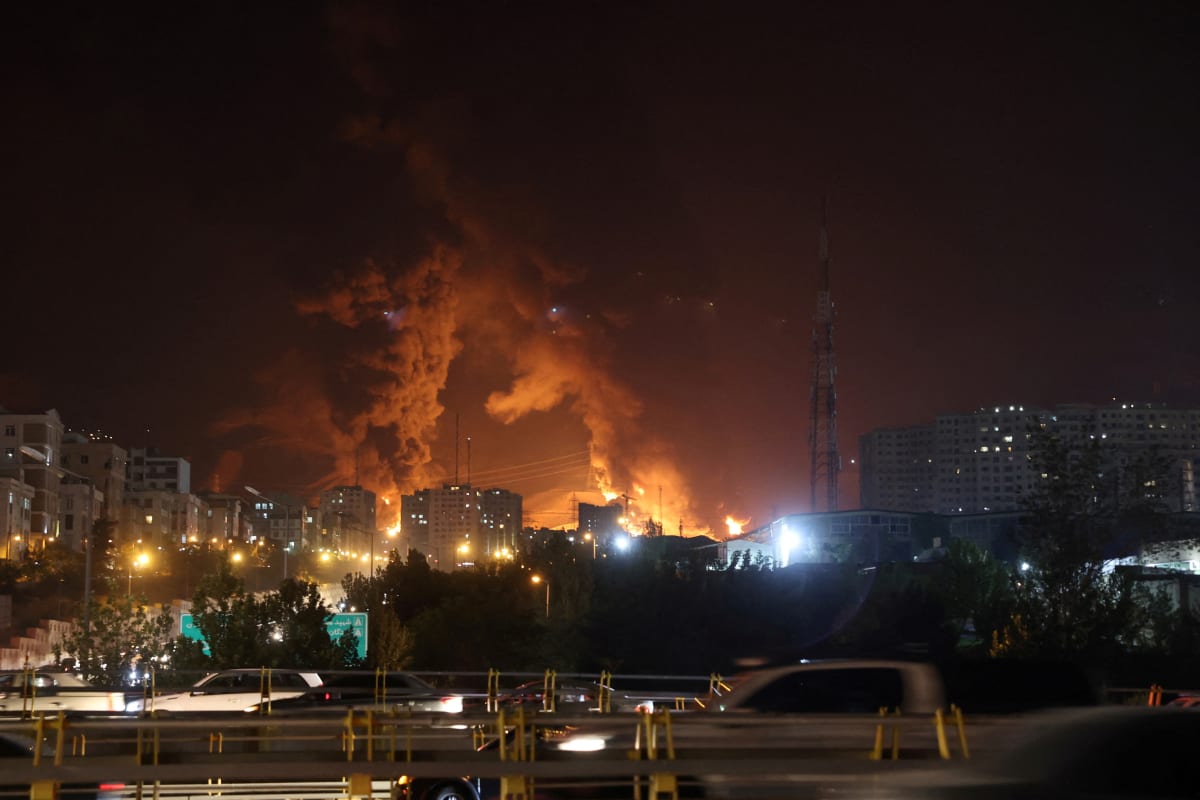
On June 12, the International Atomic Energy Agency (IAEA) declared Iran was violating its non-proliferation obligations for the first time in twenty years, prompting Iran to announce it would open a secret uranium enrichment site. The next day, Israel launched a unilateral military strike against Iran, targeting nuclear facilities, missile factories, senior military officials, and nuclear scientists. Iran’s Foreign Minister Abbas Araghchi declared the attack “an act of war,” and Iran retaliated by launching waves of drones and dozens of ballistic missiles. Israeli Prime Minister Benjamin Netanyahu described the operation as a last-resort effort to prevent Iran from acquiring nuclear weapons. Although the Trump administration had recently resumed nuclear negotiations, President Trump increasingly voiced support for Israel’s objectives and signaled his openness to regime change in Tehran. The United States stated it was not involved in the operation, but Trump claimed that Iran had brought the attack on itself by refusing to accept an agreement.
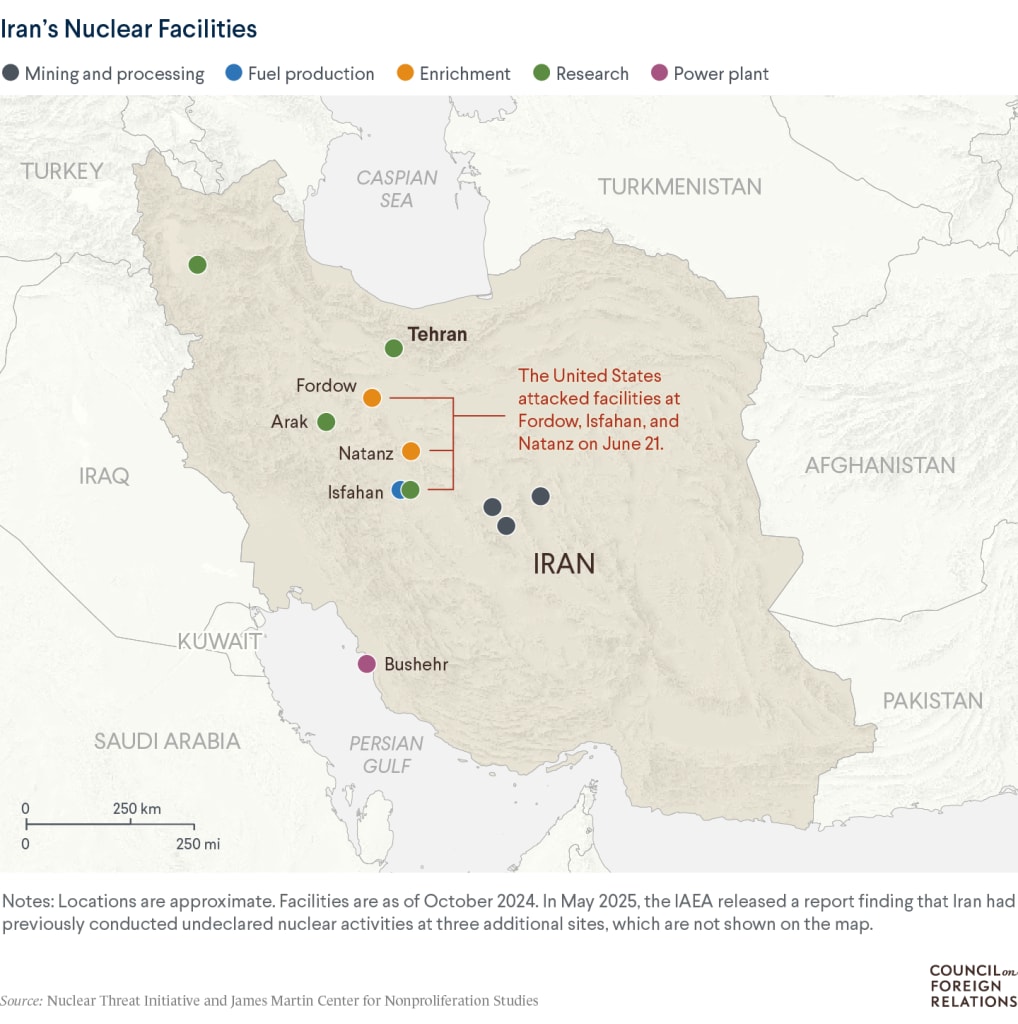
Following a week of air strikes between Israel and Iran, the United States directly intervened in the conflict, attacking three Iranian nuclear sites in Fordow, Isfahan, and Natanz with bunker-buster bombs on June 21. The Trump administration claimed the strikes significantly hindered Iran’s capacity to achieve weapons-grade uranium, but the head of the UN nuclear watchdog assessed the program was set back by a matter of months. Trump is the first U.S. president to attack another country’s nuclear program and the first to explicitly join Israel in an attack on an adversary. Iran retaliated on June 23, launching a missile attack on U.S. forces stationed at the Al Udeid Air Base in Qatar; no casualties were reported. Trump announced a ceasefire later that day. Although both sides accused the other of continuing strikes, the truce has largely held.
History of Iran’s Nuclear Program
Iran has pursued a nuclear program since at least 1957, with varying degrees of success. During a war with Iraq, Iran decided to develop nuclear weapons to ensure its security in the late 1980s. Consequently, throughout the 1990s Iran pursued agreements with China and Russia to support the program’s research. In the summer of 2002, the National Council of Resistance of Iran, an umbrella organization made up of Iranian dissident groups, exposed the existence of two Iranian nuclear sites that were hidden from the IAEA.
By 2003, diplomats launched an intensive effort to halt Iran’s nuclear program. Iran agreed, insisting only on keeping its centrifuges for nuclear energy. However, it did not follow through on its transparent reporting commitment to the IAEA and continued covert activities, leading to a June 2004 rebuke and a September 2005 finding of non-compliance by the IAEA, paving the way for a future referral to the UN Security Council (UNSC). In 2006, the UNSC adopted Resolution 1696, the first legally binding call for Iran to suspend its uranium enrichment program. Over the next few years, the UNSC adopted a series of resolutions imposing crippling economic sanctions on Iran for its failures to suspend its enrichment-related activities.
Between 2011 and 2015, the compounding effects of international sanctions led Iran’s economy to contract by 20 percent and unemployment to rise to 20 percent. In 2013, Hassan Rouhani, a noted pragmatist, won Iran’s presidential election, campaigning on a promise to lift sanctions and restore the economy. Over the next two years, the United States convened several rounds of bilateral talks and led the other P5+1 coalition members—China, France, Germany, Russia, and the United Kingdom—in negotiations with Iran’s new leadership. These efforts culminated in the adoption of the JCPOA in 2015. Once key parties signed the agreement, the UNSC approved UN Resolution 2231, paving the way for sanctions relief.
The JCPOA required Iran to reduce its stockpile of enriched uranium by 98 percent for fifteen years, cut the number of operating centrifuges by two-thirds for ten years, and provide inspectors access to enrichment facilities within twenty-four days if the IAEA suspects violations. Moreover, if the IAEA confirmed violations, the JCPOA allowed for the immediate reinstatement of sanctions. After the JCPOA entered into force on January 16, 2016, Iran received sanctions relief totaling nearly $100 billion. However, Iran continued to develop ballistic missiles, which, according to the United States, violates UN Resolution 2231.
Iran’s Regional Proxies
Though the JCPOA limited Iran’s nuclear ambitions, its regional ambitions continued to grow. Iran persisted in arming and training Shiite militants through its Quds Force—the international arm of the Islamic Revolutionary Guard Corps (IRGC)—which has exacerbated sectarian divisions in the Middle East. Iran has provided years of military aid and training to the Palestinian militant group Hamas, which enabled its October 7, 2023, attack on Israel. The Quds Force has also provided advanced armed drones to Hezbollah in Lebanon, trained and funded more than one hundred thousand Shiite fighters in Syria, supplied ballistic missiles and drones to Yemen’s Houthis, and helped Shiite militias in Iraq build missile capabilities.
The U.S. government considers Iran to be the foremost state sponsor of terrorism, spending more than one billion dollars on terrorist financing annually. There are between 140,000 and 185,000 IRGC-Quds Force partner forces across Afghanistan, Gaza, Lebanon, Pakistan, Syria, and Yemen.
Trump’s First-Term Clash With Iran
Because the JCPOA only addressed Iran’s nuclear program—and not its revisionism or ballistic missile programs—the first Trump administration withdrew the United States from the agreement, pledging to seek a more comprehensive deal. In 2018, the Trump administration began reimposing sanctions on Iran and demanded that European countries withdraw from the JCPOA as part of a new containment strategy. U.S. sanctions sparked the worst economic crisis Iran has faced in forty years, cutting Iranian oil exports by more than half and emboldening Iranian hardliners.
While the Trump administration pursued a strategy of maximum pressure to bring Iran to the negotiating table, Iran began to contravene the JCPOA’s restrictions on its nuclear program, raising tensions. In April 2019, the United States designated the IRGC a terrorist organization. When the Trump administration received intelligence of potential Iranian attacks on U.S. troops, it deployed bombers, carriers, and additional forces to the Middle East. Over the next month, six oil tankers in or near the Strait of Hormuz were attacked, which U.S. government officials blamed on Iran.
In late June 2019, Iran downed a U.S. Global Hawk drone in the Strait of Hormuz; President Trump ordered a cyberattack and the imposition of new sanctions in response. On December 31, Trump blamed Iran for backing protests that tried to seize the U.S. Embassy in Baghdad. Days later, tensions peaked when the United States killed Qasem Soleimani, the commander of Iran’s Quds Force, in a Baghdad air strike. In response, Iran said it would no longer adhere to restrictions under the nuclear deal, and it accidentally shot down a Ukrainian passenger plane while on high alert. In late 2020, Trump continued to ratchet up sanctions, and Iran boosted uranium enrichment to levels well beyond the limits of the nuclear deal after one of its top nuclear scientists was killed.




Iranian Military Drill
The Iranian Revolutionary Guards Navy conducted large-scale drills in the Strait of Hormuz and Gulf of Oman, firing cruise and ballistic missiles as well as drones at simulated targets (AP). Iran warned the United States to avoid approaching its forces during the exercises (Newsweek). Iran also hosted a separate Shanghai Cooperation Organization counterterrorism exercise, with Azerbaijan, Iraq, Oman, and Saudi Arabia participating (Reuters).
Iran’s Domestic Crises
Officials and experts are warning about Iran’s deepening drought, which has left major reservoirs near empty and raised the possibility of water rationing and temporary evacuations from major cities; researchers say decades of water overuse, aging infrastructure, and climate-driven heat have contributed to the crisis (Forbes). Meanwhile, Iran’s economy continues to struggle, with its currency hitting an all-time low of 1.2 million to the U.S. dollar amid UN-snapback sanctions and U.S. pressure that constrain economic activity (AP).
Iran Nuclear Negotiations
France announced that Foreign Minister Jean-Noël Barrot will meet with Iran’s Abbas Aragchi in Paris on November 26 to address Iran’s nuclear obligations and other security challenges, amid Iranian cooperation with the International Atomic Energy Agency collapsing (Reuters).
Iran-IAEA Tensions
Iran said it would stop allowing the International Nuclear Energy Agency (IAEA) to inspect some of its nuclear sites yesterday, following the passage of an IAEA resolution demanding Iran provide exact information about nuclear sites “without delay” (WaPo). Iran had warned that the resolution would negatively affect cooperation; it had granted the agency only partial inspection authority following U.S. and Israeli attacks on its facilities in June (Reuters). Despite these tensions, France reiterated that European powers seek to negotiate with Tehran and invited Iranian officials to talks before the end of the year (Reuters).
Iran’s Nuclear Stance
Iran’s foreign minister told a press conference that Tehran is not conducting undeclared uranium enrichment; he said Washington’s approach to nuclear talks does not suggest it is not ready for “equal, fair negotiations,” but left open the possibility of such talks in the future (AP).
Iran Seizes Oil Tanker in Strait of Hormuz
Iranian forces intercepted a Marshall Islands-flagged tanker, the Talara, and directed it into Iranian waters, according to a U.S. defense official who said American surveillance drones monitored the incident, which was the first in several months (AP). The tanker’s manager later affirmed that the entire crew was safe, while the ship remained anchored in Iran’s Bandar Abbas Port (Reuters).
Iran Flaunts Military Capabilities
The Iranian Revolutionary Guard Corps publicly displayed domestically-manufactured missiles for the first time since its June war with Israel and the United States, as reports suggest that Iran has significantly accelerated its weapons production levels in preparation for a new war with Israel (AP). Meanwhile, in Canada, Canadian Security Intelligence Service Director Dan Rogers gave a rare speech stating that his agency thwarted several potentially lethal Iranian plots against opponents of the Tehran regime this year (Reuters).
New Iran Sanctions
The U.S. Treasury Department issued sanctions against thirty-two individuals and entities across various countries, including China and the United Arab Emirates, that it accused of supporting Iranian weapons production (Reuters). This is the second tranche of new sanctions imposed by the Trump administration on Iran since UN sanctions on the country snapped back earlier this year following the full expiration of the 2015 nuclear deal (Bloomberg).
Iran Reports IAEA Inspections
Iran’s Foreign Ministry said International Atomic Energy Agency inspectors toured several nuclear facilities last week in response to the watchdog’s demand that Tehran “seriously improve” cooperation and grant access to sites in Fordow, Isfahan, and Natanz (Reuters).
Iranian Plot to Kill Israeli Envoy
A U.S. official stated that the Islamic Revolutionary Guard Corps planned an assassination attempt against Israeli Ambassador Einat Kranz Neiger in Mexico, but the plan was disrupted earlier this year and poses no ongoing threat; Israel thanked Mexican authorities for thwarting the network, as Western governments accuse Tehran of escalating global plots against diplomats and dissidents (Reuters).
Iranian Private Outreach to the United States
President Donald Trump stated that Iranian officials have been reaching out to the United States to ask whether U.S. sanctions could be lifted, even as Iran publicly refutes negotiation attempts; Trump reiterated that he is open to talks (Reuters).
French and Iranian Prisoner Releases
Iran freed two French nationals previously jailed there, French President Emmanuel Macron said; the move follows France’s conditional release last month of an Iranian student who was jailed earlier this year (Reuters). French President Emmanuel Macron and Iranian Foreign Minister Abbas Araghchi separately voiced hope that the detainees could return home (DW). The Iranian detainee, Mahdieh Esfandiari, was arrested on accusations of promoting terrorism on social media, while the two French citizens, Cécile Kohler and Jacques Paris, were arrested in 2022 on espionage charges (France24).
Khamanei Refuses Negotiations With United States
Iranian Supreme Leader Ali Khamenei claimed that Iran would not negotiate with the United States over its nuclear weapons program as long as U.S. support for Israel continued (Reuters).
Maximum Pressure Campaign Accelerates
U.S. Treasury Undersecretary John Hurley will visit multiple Middle Eastern states to discuss efforts to restrict Iranian sanctions evasion as Washington renews its “maximum pressure” campaign after UN snapback sanctions were reinstated in September; discussions will also cover attempts to challenge Iran-aligned groups (Reuters). Meanwhile, the Institute for the Study of War cited rumors that senior Iranian military leadership, including Islamic Revolutionary Guards Corps Commander Major General Mohammad Pakpour and Deputy Chief of Staff for Political and Security Affairs Ali Asghar Hejazi, have been making policy decisions independently of Iranian Supreme Leader Ali Khamenei, marking a major shift in Iran's governance structure if true (ISW).
Activity Near Iran’s Uranium Stockpiles
International Atomic Energy Agency chief Rafael Grossi told the Associated Press that inspectors have not observed renewed enrichment beyond levels preceding the June conflict with Israel and the United States but detected recent movement around sites holding uranium enriched to 60 percent; Grossi warned that the agency lacks full access to confirm the uranium has not been diverted, even as inspectors remain in the country (AP). Meanwhile, European security agencies reported that China has delivered sodium perchlorate, a key ingredient in the production of Iran’s ballistic missiles, to the Bandar Abbas port despite the recent reimposition of UN snapback sanctions; analysts suggest that technical ambiguities in procurement networks may enable Beijing to claim compliance with international regulations (CNN).
Iran Pushes Solar Energy
Tehran is accelerating renewable energy development to curb worsening power shortages caused by years of global sanctions and underinvestment in infrastructure; renewables currently account for just 2.5 percent of electricity generation, with a target of twelve gigawatts within three years (FT). Meanwhile, Iranian Foreign Minister Abbas Aragchi claimed that Iran would refuse to return to nuclear talks with world powers until the United States drops what he called “unreasonable demands” (Reuters).
Khamenei Refutes Washington
Supreme Leader Ayatollah Ali Khamenei dismissed U.S. President Donald Trump’s proposal for renewed negotiations and refuted his claim that U.S. strikes destroyed Iran’s nuclear infrastructure, saying Washington’s actions amounted to “bullying” following June’s twelve-day air war targeting Iranian sites (Newsweek). Meanwhile, Iran’s Supreme National Security Council formally ended cooperation with the International Atomic Energy Agency, weeks after Foreign Minister Abbas Araghchi hinted at such a move (Reuters). Most of Iran’s enriched uranium remains intact despite Israeli and U.S. attacks in June, IAEA Director Rafael Grossi said today (Times of Israel).
Iran Continues Withholding IAEA Access
Wall Street Journal Correspondent Laurence Norman reported that Iran has yet to provide reports on or set inspection dates for damaged nuclear facilities under its Cairo deal with the International Atomic Energy Agency (IAEA) (X).
Trump Says U.S. Is Committed to Nuclear Talks
Speaking to Israel’s Knesset, U.S. President Donald Trump said Washington is prepared to reach a new deal with Iran “when Tehran is ready;” on Saturday, Iranian Foreign Minister Abbas Aragchi said Tehran would consider any “fair and balanced” U.S. proposal but noted no formal offer had yet been received (Reuters).
Revelations on China-Iran Cooperation
The Wall Street Journal reported that China is secretly paying for Iranian oil by swapping crude for infrastructure projects, bypassing U.S. banking sanctions; state insurer Sinosure and the shadowy firm Chuxin channel billions in oil revenue to Chinese builders in Iran, deepening a twenty-five-year strategic pact (WSJ).
Iranian Foreign Minister Deems Nuclear Oversight Irrelevant
Foreign Minister Abbas Araghchi said Tehran’s cooperation with the International Atomic Energy Agency is “no longer relevant” after Britain, France, and Germany triggered snapback sanctions, warning the move would undercut Europe’s leverage in nuclear talks; Araghchi said Iran will soon announce its stance on future cooperation, as diplomacy remains feasible (Al Jazeera).
U.S. and Israeli Pressure Pushes Growing Fears in Iran
The Trump administration’s push to reimpose UN “snapback” sanctions on Iran is straining its economy and fueling concern of renewed Israeli attacks, per the Washington Post; Israel, which struck Iran in June, has hinted it may strike again, while Arab and European officials continue pushing for diplomacy (WaPo).
New U.S. Sanctions Target Iran
The U.S. Treasury sanctioned twenty-one entities and seventeen individuals for supplying Iranian forces with technology for ballistic missiles and military aircraft (U.S. Treasury).
U.S. Deportations to Iran
The United States deported a planeload of Iranians to Tehran this week as part of an agreement between the two countries, an Iranian foreign ministry official said; the wife and lawyer of one deportee said he was a political dissident who was forced onto the flight (NYT). Poor bilateral diplomatic relations in recent years have hindered cooperation on deportations (Politico). A White House spokesperson said the move was in line with the Trump administration’s commitment to carry out the largest mass deportation operation in history (BBC).
UN Reimposes Nuclear Sanctions After Ten-Year Hiatus
The economic penalties had been lifted in 2015 as part of a deal in which Tehran agreed to limits on its nuclear program; although Washington pulled out of the nuclear accord in 2018, the deal remained in place, even as Iran accelerated its enrichment activities (NYT). The United States and European countries say they still seek to curb Iran’s nuclear activities through negotiations, but the sanctions snapback underscored how such diplomacy has grown more strained in the wake of Israeli and U.S. strikes on Iran earlier this year (Bloomberg). The United Nations reinstated an arms embargo on Iran, as well as asset freezes and travel bans on some Iranian entities and officials; the sanctions also authorize countries to stop and inspect cargo going to and from Iran (NYT). To stave off the sanctions, Europe had called on Iran to allow outside inspections of its nuclear facilities, to disclose the location of its highly-enriched uranium stockpile, and to open direct nuclear talks with the United States (BBC). Iran’s President Masoud Pezeshkian said that Tehran agreed to negotiations and inspections—but rejected Washington’s demand that Iran hand over the entirety of its stockpile in return for a three-month suspension of the snapback (Bloomberg). Following the snapback, Iran recalled its ambassadors to France, Germany, and the United Kingdom for consultations (Reuters).
Iran Threatens to End Nuclear Oversight
Foreign Minister Abbas Araqchi warned that Tehran will cancel its new inspection deal with the International Atomic Energy Agency if Western powers reinstate UN sanctions under the “snapback” mechanism, which Britain, France, and Germany triggered over Iran’s nuclear violations (Reuters).
Iran Likely Carried Out Secret Missile Test
Satellite photos analyzed by the AP show scorch marks at Iran’s Imam Khomeini Spaceport, indicating an undeclared missile launch may have occurred last week; Tehran has not confirmed the launch, but a parliament member claimed a successful intercontinental ballistic missile test, though without providing any evidence (AP).
Iran Rebuilding Missile Sites
Satellite images show Iran is repairing missile-production facilities damaged by Israeli strikes in June, but Tehran still lacks planetary mixers, which are crucial for making solid-fuel missiles; experts say that the regime may seek to obtain these mixers from China and that the overall rebuilding efforts demonstrate Iran’s priority to restore deterrence as fears remain of a renewed war with Israel (AP). Meanwhile, Iranian President Masoud Pezeshkian told the UN General Assembly that the June U.S. and Israeli attacks dealt a “grievous blow” to peace efforts; he also accused Europe of operating in “bad faith” on the 2015 deal, as talks proceed over the possible snapback of UN sanctions (Politico). Iranian Oil Minister Mohsen Paknejad stated that Tehran’s exports to China will continue even if the snapback sanctions return, as sales to China currently account for the majority of Iran’s oil revenue (Reuters).
No Breakthrough From Nuclear Talks With Europeans
Iran’s talks with representatives from the European Union, France, Germany, and the United Kingdom yielded no tangible results even as a Saturday deadline to impose new UN sanctions nears, barring new commitments from Iran (Politico). Separately, Iran’s top leader said in televised comments that he rejected the prospect of direct negotiations with the United States on the matter (AP).
Iran’s Nuclear Chief Arrives in Moscow for Nuclear Power Plant Deal
Iran’s atomic energy chief Mohammad Eslami arrived in Moscow to sign agreements with Russia, including plans for eight new nuclear power plants, even as the UN Security Council considers reimposing sanctions on Tehran over its nuclear program (Reuters).
Iran Denies Reported Meeting With Europeans Amid Sanctions Threat
An Iranian Foreign Ministry official denied reports that Foreign Minister Abbas Araqchi would meet British, French, and German officials in Vienna, suggesting he is instead headed to New York; the European powers have offered to delay reimposing UN sanctions for up to six months if Tehran allows inspector access and engages in talks (Reuters).
UN Security Council Rejects Iran Sanctions Relief
The UN Security Council voted 9–4 against permanently lifting sanctions on Iran, with two abstentions, instigating the return of European sanctions by September 28 unless a deal is reached; Russia, China, Pakistan, and Algeria opposed the reintroduction of sanctions, while Iran condemned the move as “politically biased” (Al Jazeera).