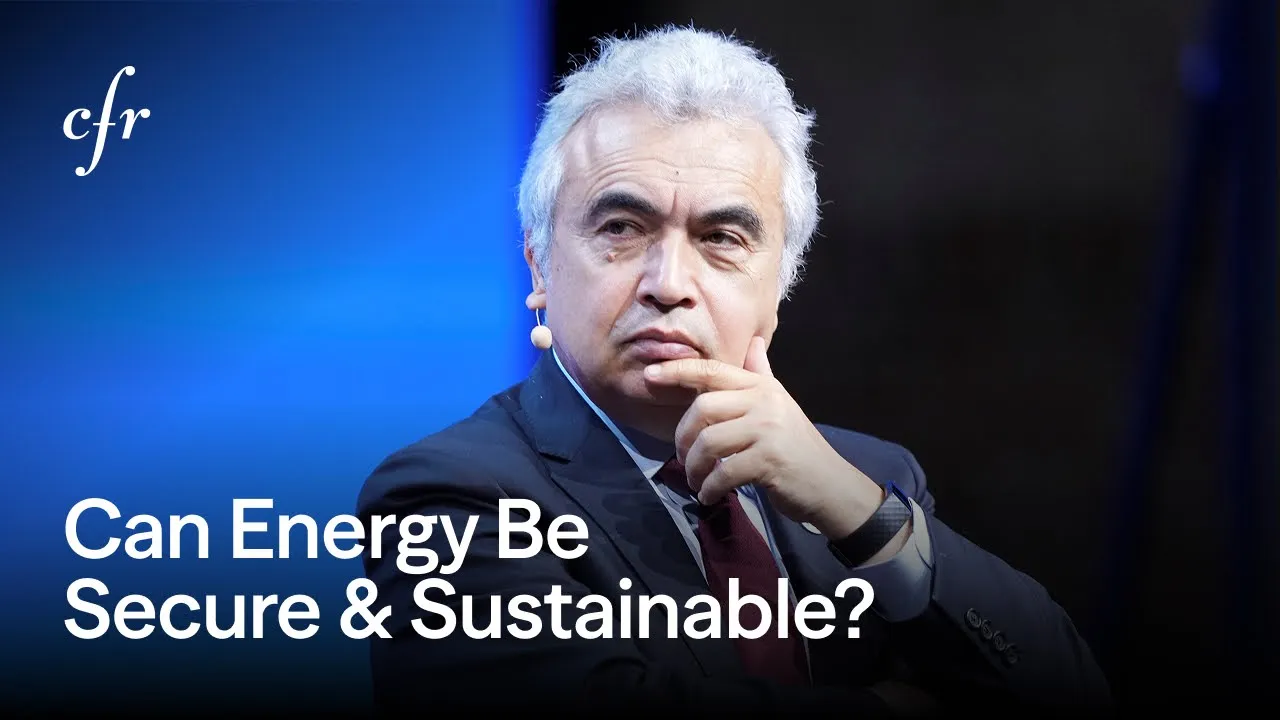
A Conversation With International Energy Agency Executive Director Fatih Birol
Event date
Speaker
- Executive Director, International Energy Agency
Presider
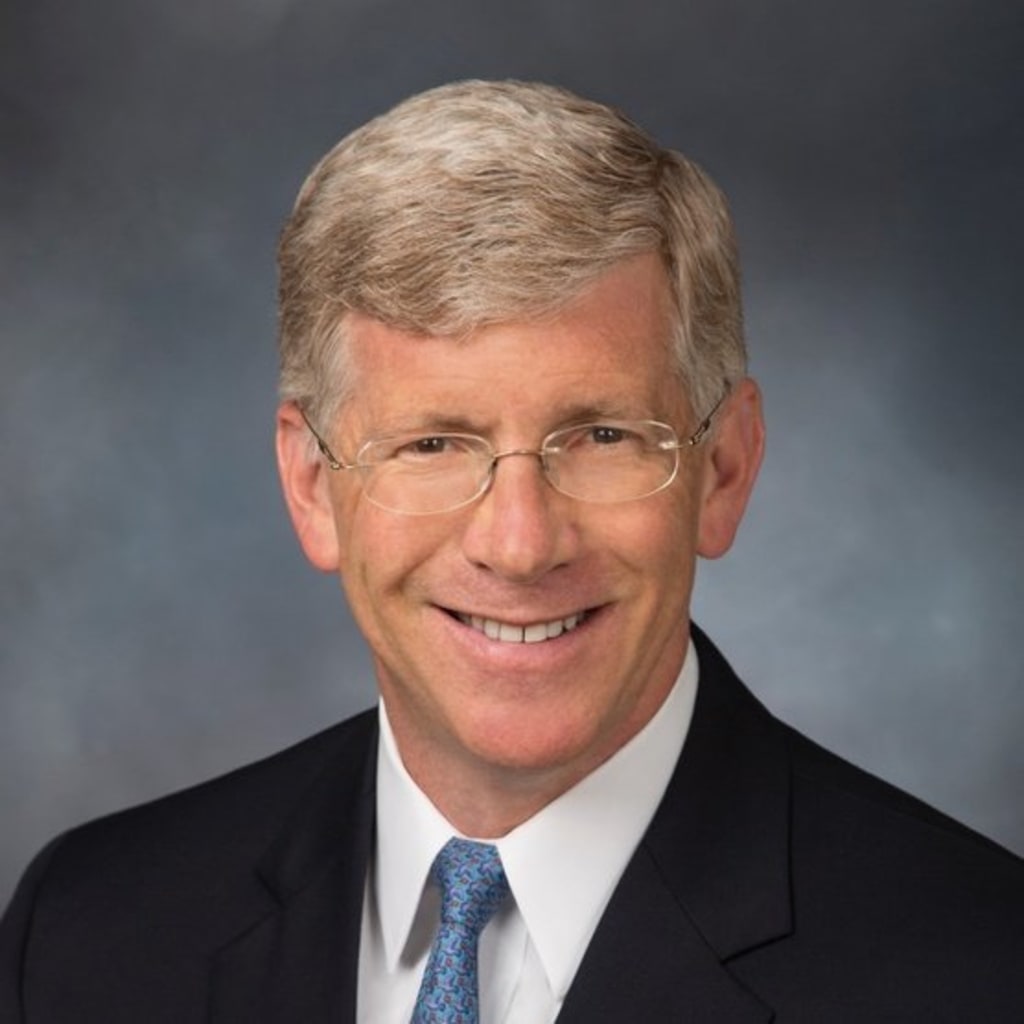 Daniel B. PonemanCFR ExpertSenior Fellow, Council on Foreign Relations; Former Deputy Secretary and Chief Operating Officer, U.S. Department of Energy (2009–2014)
From Climate Realism.
Fatih Birol shares insights on the current state of global energy markets, emerging risks to energy security, and the steps government and industry leaders must consider to ensure a more affordable, secure, and sustainable energy future.
This meeting is presented in partnership with CFR’s Climate Realism Initiative.
PONEMAN: Well, good afternoon, everyone. Let’s have a “good afternoon” back, just to show you—just to show you’re alive. (Laughter.) Good. Thank you. I am delighted to be welcoming everyone here, both online and in person, to this Council on Foreign Relations session with the International Energy Agency Director General Fatih Birol, who is an old and dear friend, and a genuine subject matter expert. My name is Dan Poneman. I’m a senior fellow here at the Council on Foreign Relations. This meeting today is on the record.
And I will just say a quick word about Fatih, because I’m sure he’s well known to all of you. He comes by his expertise honestly. I think when I first met Fatih he was the chief economist of the International Energy Agency. He actually began his career in OPEC. This was a diversion from his real passion of football, but we can get into that in the Q&A, perhaps. (Laughter.) And I would just say that when I had the opportunity to see Fatih move from the chief economist role to running the agency, it was really, I think, a transformational moment. And Fatih has really become a global figure. You cannot see a major energy conversation happening anywhere in the world anymore, at the head of state level, without seeing Fatih right in there providing the expertise and the judgment.
We have not that much time, and we have a lot of ground to cover, so let’s kick it off. It’s hard to believe—some of us remember October 1973 and the oil crisis that gave rise to the creation of the International Energy Agency. So let’s, Fatih, start by going back to your roots. We’ve had lots of disruptions in the oil market. We are—it’s a little surprising to see prices where they are today, given all the disruption. Also you just came out recently with a very interesting report that says just to keep our current levels of production up it’s going to require a lot more investment than I think many people had contemplated. How should we think about today’s oil market?
BIROL: Thank you very much, Dan. So good afternoon. Bon appetit to everybody here. Dan, thank you. It’s a great honor to be with you once again.
So about oil markets, there’s a lot of controversy. There’s a lot of discussion on oil markets and our positioning there. But we have a very clear position, all based on data. What we see, Dan, two different trends. One, under oil production. There is a big production growth of oil coming from Americas—U.S., Canada, Brazil, Argentina, Guyana. I call them the American quintet. You like jazz—
PONEMAN: I love jazz.
BIROL: I know, I know. Mostly is quintet, so, you know, that—
PONEMAN: Thank you.
BIROL: And U.S. is a trumpet, by the way. So U.S. is—the biggest growth comes from U.S. It’s a very strong growth coming from here, production growth. But demand growth is slowing down globally. It’s slowing down. Whatever you write in tweets, articles, speeches, it is slowing down. Mainly because of China. In the last ten years, Dan, more than 60 percent of global oil demand growth came only from China, 40 percent everybody put together. And now Chinese oil demand growth is slowing, mainly because the Chinese economy is slowing down, which everybody agrees—the financial institutions in this country, the IMF, Chinese Communist Party. Everybody agrees, for obvious reasons. Plus, the electric cars.
So therefore, we said, for example, last year, 2024—big controversy. We said, dear colleagues, at the end of 2023-2024, global oil demand will slow down and increase less than one million barrels per day. There was a big outcry. IAE is saying this slow down because of climate, because of this and that. Some of the other institutions said they will never be below two million. One million versus two million. And at the end of today, 2024 finished. And we were spot on—spot on. And I thought there’ll be again lots of tweets, lots of things, and that nobody wrote anything about this. So we are a humble organization.
And this is the way we are going to see global oil demand growth is slowing down. And but this doesn’t necessarily mean—you make a very good point—we don’t need investment in oil, because the oil fields colleagues, who are not dealing with oil on a daily basis, like the human beings, they are very productive. They come to a peak. After the peak, they start to decline, after a certain age. Mark is here. Mark knows that very well. And in order to compensate the decline in the existing fields, you have to inject money. So 90 percent of the investment going to oil today is to compensate the decline in the existing fields, only 10 percent to meet the demand growth.
So therefore, this is how we see it. But, of course, it is the reason—Dan, I’m finishing it—that since there’s a lot of supply coming from the American quintet, demand is rather weak compared to past, lots of oil in the market. Therefore, in the middle of the Middle East so many things are happening, in the world so many things are happening. Prices are still $60, comfortable prices.
PONEMAN: Well, as we discussed at the beginning, IEA was born as a creature of energy security. And from time to time in eras of abundance of energy we sometimes lose sight of that fact. February 2022 provided a brutal reminder when Europe found itself deeply and unacceptably dependent on Russian natural gas. One of the things at my time at DOE that was one of those extraordinary developments. I think, Dan Yergin said it’s—you know, the revolution of this century is the natural gas revolution. So how do we think now, Fatih, about the role of LNG, its role in basically saving Europe from itself, so to speak, and the ending of destination clauses and so forth? Where do you see the LNG market going now?
BIROL: Dan, Europe—you know, IEA is in Paris. I live in Paris. I talk, of course, with the—I came here to meet with the U.S. administration, but I meet with the European administrations, and the Japanese, and the Indian, and everybody else. But in Europe, we are in a very difficult situation as far as energy is concerned. First, the energy price(s) are much higher, a major problem for the competitiveness of the European economies. And, second, energy security is a huge risk.
If I may, Europe, in my view, in the last thirty years made three historical strategic mistake(s), historical, and it cost them for the economy, energy, and foreign policy—even foreign policy and defense.
Number one, overreliance on one single country for the energy, Russia. And we said it. When I was 2004—2004, I said it. I said it, reliance on Russia was a huge mistake. At the time we were told, but Russia never do anything wrong and they will do nothing wrong again. This is number one, big mistake.
Second mistake, Europe turn its back to nuclear power. So in end of 1990s 30 percent of the European power came from nuclear, and very soon it is going down to 15 percent. What a mistake.
And, third, today, when you look at what’s happened in the electricity markets, the number one—but 60 percent of the all-new power plants are solar panels, we like it or not. And these are 90 percent Chinese. And in effect, Europe has started the solar, put a lot of subsidies, but after a while Europe dropped the ball and Chinese took it over like in other things.
So as a result of these three strategic mistakes, Europe is in very bad shape.
Now, in my view, the most immediate one is gas. And Europe is—in fact, this gas problem Europe is facing comes at a fortunate time for the—this is very fortunate time for Europe because, as I said two years ago, as of 2026 to 2030 huge amount of LNG is coming to markets—U.S., Canada, a bit of Qatar—and it is a very good opportunity for Europe completely get it off the Russian gas and make use of the huge new LNG wave coming to the markets. It’s a golden opportunity for Europe, and it will be, I think, very good for European energy security.
PONEMAN: Well, let’s pick up on one of the things you just mentioned, which was the effect that China and its overproduction/overexport has had on solar. Of course, it’s not confined to that. And in a way, I think there’s an analogy today to the October 1973 period, where we found ourselves unacceptably dependent on OPEC oil. And now, as we move into electric vehicles and wind turbines and so forth that all depend on critical minerals, we find that both the raw materials and the processing thereof are highly, highly, highly concentrated in China. You’ve actually just published a very interesting article in Time magazine addressing this.
So, a two-part question. Number one, how do you assess the dependence on non-China countries on China and other places where there might be an excess of concentration in critical minerals? And what role do you see possibly of an organization like the IEA in addressing this? Do you have the mandate, expertise, authority, and so forth?
BIROL: It is—it is a critical issue, in my view. Energy security—when we talk about energy security, we normally think about oil or gas. These traditional energy security issues are still there, but for me the next energy security issue is the critical minerals.
Now, a few things, first of all. Critical minerals problem is not only the—they are not only used for the electric—(inaudible)—panels and so on, but they are used for defense, drones, AI, chips, manufacturing, car manufacturing, and everything.
Second thing is, then, when people think about critical minerals, there is—there is—most of the people think about the mining. Mining is one issue, and there’s already concentration there. But the most important issue, the nerve center of the problem, is the refining and processing these things.
So there are colleagues from the oil industry here. Crude oil doesn’t mean anything unless you refine it and you make out of this, I don’t know, jet fuel or gasoline or diesel or LPG. And China today—of all the strategic critical minerals, China’s share in refining is 70 percent. Seventy percent China, 30 percent everybody else put together.
First of all, Australia has 60 percent of the lithium production but it can process only 2 percent of it. Australia sends it to China and then after, when it finishes, takes it back.
So the world has slept. And China built since ten years, in a very well-organized, strategic way, their large-scale manufacturing capacity, all this refining, and the world is today—is facing a major challenge.
I am not saying that China will do this or China will do that. Any country—because for me the number-one rule of energy security—golden rule—is diversification. We go here to concentration.
And again, this is not only for the clean energy transition. This is for the drones. This is for jets, AI, car manufacturing, and everything. I mean, we had a couple of examples recently. In April, I think, China stopped export of certain minerals, and the car manufacturer(s) around the world were in panic, OK?
So, therefore, there is a—and we cannot leave it. It is so—it is so concentrated, Dan, that we cannot leave everything to the market and just sit back. There is a need for government’s move. And U.S. or any country cannot do it alone. There is a need for international cooperation here. I don’t know, U.S., Europe, Canada, Australia, India, whatever, they should come and work in a concentrated way. And more diversification needs to come there.
PONEMAN: No, I remember when I was first studying energy as an undergraduate we were asking ourselves the question—this is in the early 1970s—is energy just a commodity like any others or is it something special that has a security imperative associated.
That question has been definitively answered, and your comment about diversification reminds me of the famous line from Winston Churchill when he was first Lord of the Admiralty—I think it was 1913—that energy security comes from variety and variety alone.
BIROL: Exactly. Yeah.
PONEMAN: I also couldn’t—when you were talking about China, about ten years ago I was talking to a Chinese colleague in the nuclear industry and, you know, they have a lot of things there but they don’t really have a lot of uranium, and this gentleman was telling me that they had extensive uranium resources and I said, really? I said, I hadn’t seen it—where are they? He said, South Carolina. (Laughter.)
You didn’t see that coming.
BIROL: And then in the choice of China it is—it is not a political thing. There can be, I don’t know, earthquake. There can be a fire. Just getting all the supply from one single person, one single country, is always risky. I completely agree.
PONEMAN: It’s folly. Yeah, it’s a folly.
OK. So you also mentioned in passing the thing that is on everybody’s mind these days, which is AI, and the statistic that—there’s many, many statistics and I’m sure a lot of inaccuracy, but talking about going from 4 percent to 12 percent of demand by 2030 or I think McKinsey reported that last year datacenters in the U.S. used about 21 gigawatts of power and by 2030 it’s supposed to be 70 gigawatts, which would be like the equivalent of 50 full-size nuclear power plants.
It’s just—now, there may be some double counting in there but it’s a lot, right? So talk to us—and so having in this country seen basically a very flat for many, many years demand curve take this vertiginous upward direction and the desire for datacenters, and each new large language model requiring more and more megawatts just to train the model and so forth, how does that intersect in your supply-demand analyses? And how are we possibly going to meet the moment?
BIROL: So, then, the AI—therefore, the datacenters needs a lot of electricity, and they need it 24/7. Just to put in a context—there are many numbers, but I will give only two numbers—one medium-sized datacenter, as they are mushrooming around the world, consumes electricity as much as a hundred thousand households. So just to put in a context. And second, according to our analysis, I think it is more or less everybody uses that one, between now and 2030 about half of the U.S. electricity demand growth we come from AI. Other half, everything has put together. So big, big growth.
Now, why it is important. So I think there are many colleagues who know better than me here there is a big race on AI and technology. And we all know that AI has the capacity to transform the—or change the balances in global economic and political power in the world. Now here, when I look around the world, countries who have already available electricity supply will be a few steps in front of the others. And in U.S. and in Europe, I can tell you that the electricity supply is a major problem—major problem. And it is—it will be not easy.
For example, in China it is not. In China it is not, largely because of manufacturing capacity. And even today in Europe, if you want to build a gas turbine, if you go to see one manufacturing company, they give you 2035, the first one you can get. There is a queue. You have to wait for that. But China, it’s not the case. So we should—in Europe, in U.S., I don’t know, in Canada, elsewhere, it is very important that we find ways how to increase the electricity generation supply here. And if we are not able to do that, we may be a few steps behind other countries. There is no AI without electricity.
PONEMAN: I have heard it said that, as between GPUs and megawatts, the tighter constraint on AI is megawatts. I don’t know if that’s true, but that—is it’s certainly been said. Well, I was hoping you would say the word first, because when we’re talking about this huge requirement of firm, reliable power, the mind naturally gravitates to nuclear.
BIROL: For you, of course, yeah.
PONEMAN: And so that’s why I was hoping you would say at first. But in any event—and I am going to avoid the word and hope everyone avoids the word, “nuclear renaissance,” because I always thought that was bad karma in 2007. I still think it is. That said, there is a bow wave of demand. And you live in Europe. The good European phrase “zeitgeist” has—I think—I just was in Paris, as you know, a week ago—has clearly shifted. So how do you see—and there’s now both—well, there’s demand for effectively anything and everything, from upgrades of existing plans to life extensions. IEA has published a lot on this over the years.
There’s now demand. And the administration has—the president has issued four executive orders calling for ten big plants to be in construction by 2030. Many other advances in advanced reactors, small modular reactors, and so forth. How do we think about the component that nuclear will play? How do you see that evolving? And, since you are based in Europe where there has been so much controversy over the years, help us understand the evolution of thought in Europe.
BIROL: I think in Europe, and in the world—you don’t like to world “renaissance,” but I can tell you that I believe nuclear is making—in fact, not—did make a comeback. And, to be honest with you, we—especially in Europe—we owe this to one single person. Vladimir Putin. Because Europe went back to nuclear as an energy security option. But you know what? Not only in Europe, but also in U.S., many countries, and Japan, this political zigzags are so bad—stop and go. And you know much better than anybody that the nuclear needs a long-term vision, long-term strategy, and long-term commitment. You go and you stop. No—government change.
In France, we have 75 percent electricity coming from nuclear power. And President Macron—whom I like very much—in my research very much when he came to power six, seven years ago—he wanted to bring the share of nuclear from 75 percent down to 50 percent because he had a coalition with another party. And they asked me, what do we think about this? We always say the truth, or we think what the truth is. I said, France shutting down the nuclear power plants is something like selling the Eiffel Tower to somebody else, because it’s a national asset of France. But now President Macron is pushing it very strongly. Even Germany is now have a different mindset when it comes to nuclear power. And many people in Europe.
Now, but the good news is why I say come back. Data today for the first time since thirty years, maybe twenty-five years, as we speak now seventy gigawatts of nuclear power plants are under construction in fifteen different countries. We have never seen this, under construction. This is happening. And here I think the political momentum is in the right direction. Now industry needs to deliver. This is another story altogether. Industry doesn’t—nuclear industry—so sorry to say this—but most of the nuclear industry, I should say, they don’t have a very good track record of delivering on time and on budget. And I think they should—hopefully they will make the best out of this situation now, and this mood.
And with the AI coming there and we have a wonderful client, which is a deep pocket, needs a lot of electricity. There is a very, very nice couple there. And both in terms of the commercial nuclear but also small modular reactor, different—how shall I say—different combinations can be part of the game. But I believe nuclear will have a much stronger share in the generation mix in the future than today.
PONEMAN: All right. I’m just going to ask a couple more questions. We want to have plenty of time for audience questions. But let’s just pick up what you were talking about in terms of the energy mix. And you know, this tripling pledge from COP-20, on nuclear, for example, would only maintain nuclear at 10 percent of global, which the tripling actually is, in a way, just treading water, right? And so over the years, I don’t know how many times—Kevin or somebody else might know—how many times we’ve had this debate over peak oil and so forth, right? And it keeps coming and going.
I remember one statistic, probably from your reports. And if I’m wrong you’ll correct me. That primary energy use is still 85 percent fossil—or, was, like, ten years ago. And after $5 trillion of investment in renewables and a huge growth, you know, in absolute terms of renewables, it’s now 83 percent or something—(laughs)—you know, nominally different. So how, putting your crystal ball on, how do you see the energy mix twenty, thirty years from now?
BIROL: So it will very much depend on government policies, which path they are going to take, the role of energy security versus the energy poverty versus climate change. What are the—what are the priorities of the governments? But, Dan, the change has happened. I’ll tell you—I’ll give you a couple of examples. For example, in 1970s about 40 percent electricity generation was coming from oil in the advanced economies. It has been replaced big time by nuclear and gas and renewable science, to 3 percent, I think. Or, in China, oil used in transportation sector was very high. And it was the main driver of the global oil demand growth. And it has already peaked. It’s now going down, mainly because of the electric cars. So, or coal. Coal was big in advanced economies generation. It is going—it is going down to single digits in some countries. So it is happening.
But globally I believe, depending on the policies, we will see renewables to grow, nuclear to grow, gas to grow for some time to come—years to come. We will still use a lot of oil in the future. And coal will be a part of the mix, especially in some Asian countries.
PONEMAN: This reminds me of your fellow energy economist Adam Sieminski, who taught me a very interesting factoid, which is we often see these charts that show the rise and fall of different energy forms. And there’s the age of wind, and the age of wood, and the age of coal, and then oil, and then gas; and there are all these curves and rise up and fall down. But if you look in absolute terms, we’re using more of everything—more wind, more coal, right, more oil, more gas, more nuclear—with one exception.
BIROL: Wood?
PONEMAN: Whale oil. Whale oil.
BIROL: (Laughs.)
PONEMAN: That has gone down.
All right. Here’s the last question. So please do prepare your questions. And I don’t know if we have a capacity to take questions from online, or? We don’t, OK. So you guys are all on the spot.
Let’s start where we began, the organization that you lead. It was born in crisis to address crises. It has served well across a number of crises. I remember when we had the Libyan crisis of 2011 when you and I were working so closely together and so forth. And now you’ve already talked in these remarks about perhaps new challenges where it comes to overdependence on critical minerals. You know, having led this organization for ten years, Fatih, how should we think about the IEA and its role? Is it going back to its knitting of its original mandate? Is it evolving to a new set of priorities? Help us think about the IEA moving forward.
BIROL: So what we have done is in the last ten years IEA was—I think somebody formulated in the—in a good way: IEA was transformed from an organization of rich man’s oil club to the—into a global energy authority. So oil is still very important for us, but we also work on gas, renewables, nuclear power, hydrogen, electric cars, AI, critical minerals. We’ve cover everything. And many important countries, such as Brazil and India, have applied to IEA to become a full member, so—which means IEA’s—geographically, we are much more representative.
We have been founded as an energy security organization. It is and it will remain the core mission of the IEA, energy security, even though the energy security definition is evolving. It is not only oil; it is gas, electricity, supply chains, and so on. But we also feel responsible to look at other issues in energy security, energy security being the core issue. One of them is energy poverty. As you know, the other one is climate change, which is also a very important topic for us. So we all look at these issues, but energy security remains the core mission of the IEA.
PONEMAN: Great. Well, thank you for teeing us lots of food for thought, lots of food for questions.
Please raise your hand. Are there microphones to go around? Yes, there are. And just identify yourself, please. Let’s start right here in the front table. Ma’am?
Q: Thank you.
PONEMAN: And just identify yourself, please.
Q: Good to see you again, Dan. I’m Caren Merrick. I’m a tech entrepreneur founding tech companies.
And for the last three-and-a-half years I served as the secretary of commerce and trade in Virginia, the datacenter capital of the world, and where we have a rich nuclear history, and working on a variety of nuclear and nuclear supply chain deals. So my question for you is—and I know, for example, that the datacenters are now becoming nuclear companies. They’re investing heavily into nuclear innovation. And we know that datacenters consume a lot of energy. And there’s a lot of work being done to help us use our energy more efficiently. And I’d like to know from your perspective what are you most interested in/where do you see progress in this whole area of helping us to use our energy more efficiently and, hopefully, reducing this overwhelming demand that we see. Thank you.
BIROL: Can I?
PONEMAN: Please.
BIROL: So thank you very much for raising the word of “efficiency.” So this is a word that we don’t hear much. The issue is, then, some countries have oil potential, some gas, some renewables, some—I don’t know—hydropower potential, but every country has an energy efficiency potential, using energy much more efficiently.
Now, I give you one example, and this is something I hope I am able to explain well. You know, today in the world we see electricity demand is exploding, so strong. And the number-one driver—number-one driver by far—of the global electricity demand growth is air conditioners. Number one. I mean, you can’t really believe it, number one. So, why it is so? Because in the U.S. 90 percent of the households have an air conditioner, but in Nigeria it is 5 percent, Indonesia 18 percent, India 20 percent. And people with increasing income levels and they become mid-income families and increasing temperature buy a(n) air conditioner.
Why I am saying this? Now, an air conditioner—an average air conditioner in Asia—let’s say developing Asia; India, Indonesia, Philippines—in order to provide the same comfort like in Japan uses three times more electricity than the Japanese air conditioners just because they are inefficient. And it means that you have to build power plants that you wouldn’t otherwise need to build. I don’t know if this is right English or not. Otherwise, you don’t need to build these things if they have the efficiency.
You are completely right. If we have the right efficiency standards, we can use energy—we can do the same things—the same light, same comfort, same, I don’t know, everything—using it more efficiently.
Now, for the AI I want to say something. We made a report two years—we were the first one again, AI and energy. And then we understood, energy industry understood, AI is a treble-maker. Why? Because it needs a lot of electricity. How are we going to bring this electricity to the datacenters? But now we are making another report that our colleague just mentioned how AI can, in fact, halve the energy industry, to use the energy more efficiently, optimize the grids, and enhance the—or, accelerate the innovation and better technologies, for example. So we are going to look at the good side of the AI, not only treble-maker but how it can be helpful. You know what I mean?
PONEMAN: Yeah. I do. And it’s both. There’s a thing called Jevons paradox, right, which says the more efficient you become at using something you use more of it. So I think it’s unassailable that the cost of the chips and the efficiency of the processing is going down, and the way of using these large language models that don’t—all of them boil the ocean, but some have more specialized applications. That’s all very good, but then as it becomes more convenient you use more. I think so far it’s kind of a wash, but hopefully in time it’ll be—it’ll be better.
I’m going to try to swing back and forth between different sides of the room. Anybody over on this—way in the back. Sir?
Q: Thank you. Isaac Stone Fish, CEO of Strategy Risks, a geopolitical risk firm.
And one of the biggest risks we’re seeing for the future is a potential Chinese invasion of Taiwan, which would have massive implications on global energy, possibly even more than air conditioners. I’m wondering what you think some of the energy implications of that invasion would be. Thank you.
BIROL: I prefer air conditioners than the war. Talk about—this is—(laughter)—it’s very tough for me.
PONEMAN: Do you want—
BIROL: Do you want to answer this—
PONEMAN: that’s an easy one.
BIROL: I mean, this is—to be honest with you, today energy security became so important around—all the countries around the world. It’s national security now. And the world is a very dangerous place. In Asia; I mean, in Europe, Russia-Ukraine, you are seeing what is happening; then Middle East. So geopolitical preoccupation of the countries are so, so strong that the energy security gets a big boost from the different countries around the world. I really hope that the energy remains a part of economy, or science and technology, and it is not just a strong, long, dark shadow of geopolitics and energy. I hope the issues you mentioned will never become the part of our daily lives, but I am not very optimistic when I look at the global picture today in Asia but also in Europe and in Middle East.
PONEMAN: That’s bracing.
Kevin.
Q: Thank you. Thanks, Dan. Kevin Book from ClearView Energy Partners. Fatih, thank you very much for this today. This is great.
I was wondering if you’d talk a little bit about your work. You started to do this towards the end of the conversation with Dan. You do something vital, critical, essential to all of us. Is it getting harder? We hear from a lot of statistical agencies about how their work gets harder for other reasons. Sometimes people don’t answer the phone, for example, for certain kinds of surveys. Is it getting easier? Can you tell us about how it’s going? Harder, easier, and, if so, why? Thank you.
BIROL: It is hard. It is not hard; it is very hard. I can tell you that. So this is the—I mean, the IEA is a—we are a small organization, OK? So I got—and Dan mentioned our study on decline rate, and I got a message from a major American international oil company. He says that this is—this should shape the narrative of our industry, the investment and decline rate issue. And I look at it, this company’s $400 billion shaping the narrative. Our budget is—if anybody wants to know, our—IEA’s budget is—one of our former board members, Vicky Bailey here—only $22 million. So when Vicky was on our board, it was 22 (million dollars); it is still 20 (million dollars), 22 (million dollars). Nothing changed there.
But energy—IEA became, I believe, an important player. Energy became important. Therefore, people are pushing us from different corners, and we are not responding to the people. There are a lot of press, the social media, and I tell my colleagues we focus on the ball.
And I’m a football man, and there is a thing in there. You focus on the ball. For me, the ball is data. We look at the data, what does the data says. But people don’t like it sometimes when you focus on the data and report the data because what you report may not be in line with what they would like to hear, or where they invest, or where their political or financial investments are.
So I’m going to—I mean, we focus on the data. We report data. But it is very hard to—not hard but very hard, I can tell you. I have a lot of bruise over time, so I—
PONEMAN: OK. Let’s go to the center. Yeah. You, sir.
Q: Thank you. My name is Henri Barkey. I’m at the Council on Foreign Relations.
My question is a bit esoteric. What about prices? Prices, in some ways, are the most important component here. I mean, today the FT has a story about how the declining price of oil is putting shale companies out of business, therefore there will be less production; maybe the price will go up. I mean, but price affects renewables, affects everything. So, starting with oil, where do you see the price of oil going in the sense that—or is there also a price that you think is the best one, to build upon her question also, of efficiency? I mean, let’s face it, what happened after ’73, efficiency increased because the price went up, right?
BIROL: Exactly.
Q: So what do you think? Is there an ideal price for oil? Thank you.
BIROL: So the efficiency improves, price effect. But also some countries, for example, Japan—I always give the example. You know Japan very well. Japan has very strict energy efficient standards and norms for everything, and they improve their energy efficiency a lot. But the price is very important.
Where do I see the prices of oil? If there are no major geopolitical events like our colleague working on geopolitics mentioned—if there are not such things or what will happen with Russia, Iran, we don’t know yet. But if there are no big changes there, I expect that we’ll continue to see downward pressure on the oil prices, as we have said two years ago, as it is exactly happening what we said, because there’s a lot of supply. There’s a lot of supply. American quintet, Trump at United States, so—
PONEMAN: I’m going to use that.
BIROL: —(inaudible)—you like it. So I—but of course, anytime there can be some surprises here and there.
So, of course, these lower oil prices have a few impact. One of them is they don’t give a boost to consumers to save energy, which is one thing.
Second, if the prices go lower than what we have now, I think in some countries including the U.S. shale there may be challenges to see some of the activities profitable. We have to—we have to admit this. But, on the other hand, in some parts of the world—many parts of the world—lower oil prices mean lower inflation, which is also good for economies. So it is important to find that balance according to country, according to the sector.
PONEMAN: Good. All right, let’s go back towards the back end. John Hauge.
Q: John Hauge, The Global LPG Partnership.
Would you discuss what you see as a future of LPG?
BIROL: With pleasure. When I look at the different oil products, I see—I mean, there are many oil products—gasoline, diesel, jet fuel. I see the biggest growth coming from the jet kerosene and LPG. Jet kerosene because Asia has just started to fly. And what I mean is that the Asians don’t use the airlines, the air travel, as much as only one, I don’t know, tenth Europeans or Americans. And this will give a big push to jet fuel. But LPG will grow very strongly. Let it grow, it will grow in in Africa, it will grow in Asia, mainly because of—this is another passion of mine, Dan. It is the cooking. I mean, you know this. Ever since OPEC times I am working. And this is the—in Africa today—but I will give you a very bit of data now.
In Africa today, four out of five families prepare their meal by in open fire using wood, agricultural waste. And it is mostly women who prepare this. And when they do it, the toxic air coming from there cause respiratory diseases. And it is one of the two reasons for premature death for African women. Every year, half a million African women die prematurely because of the respirator disease caused by the cooking. And what is the solution? There are many solutions. But the main solution goes through LPG. You give them LPG, you fix the problem. India solved this issue. I don’t know if you have anybody from India here. But in India, Prime Minister Modi, through the Ujjwala program, he gave LPG cylinders to the people and built the infrastructure. So I see LPG to grow strongly, mainly for cooking but also in some countries for the cars—in Korea, in Italy, and other countries. But LPG and jet fuel, these are two oil products I think we grow stronger than the others.
PONEMAN: Thank you.
OK, let’s go to the front table. Yes, sir.
Q: Thank you so much. Mark Finley with Rice University’s Baker Institute, and formerly with BP. Nice to see you. Thank you, to both of you, for this.
Fatih, given how much experience we’ve had with energy sanctions in recent years—Russia, Iran, Venezuela—in oil and gas, what have we learned from the application of sanctions? What works and what doesn’t? And for countries that might be interested in tightening sanctions regimes, for example, on Russia going forward, what does—what does what we’ve learned tell us about what might work and what are the additional steps that could be taken going forward? Thank you.
BIROL: So this is also another spicy question, Dan. So this is a—(laughter)—what I can tell you is I’ve—after the Russia’s invasion of Ukraine, Europe faced a major historical crisis because, as I said, the gas was coming from Russia, big time. So what we have done is, Mark, in ten days of time we came up with a plan, the ten-point plan for Europe, what they can do, Europe, to keep the lights on. Practical things. And still, economy doesn’t crash. And they follow this, and Europe went through some problems, but without—with having the lights on. Now, I follow therefore the sanctions, even though it is not our day-to-day work, on Russia, from Europe and other countries.
To be very frank, I wish it would have been effective—more effective. At the end of the day, when I look at the pluses and minuses, if it was more effective the situation, the overall political situation, would have been very different. Because Russia’s economy heavily, heavily relies on oil and gas revenues. If the sanctions were successful and effective, we wouldn’t be in this situation. And I stop here.
PONEMAN: Yeah. I’m reminded many of us had General Scowcroft as a mentor. And he used to say the record of unilateral sanctions is one of unblemished failure. So, I mean, it seems if you don’t get everybody, it doesn’t work. And again, going back to 2011, the Congress passed Iran sanctions. And we had all the analyses run. And there was deep concern from the analytical community that Iran would win. In other words, that the decrease in Iranian oil exports caused by the sanctions will be overcompensated by the spike in the world’s oil prices. And our CFR president, then administration official, Mike Froman and I got on airplanes. And we went to the producers who had access in Saudi, and UAE, and Kuwait. And they promised to pump.
And then we went to the consumers, it’s hard to believe now that this was successful, Turkey, and China, India, Japan. And the sanctions worked because we got both the consumers to cut demand and suppliers to boost supply. So that’s a hard thing. That’s a hard—
BIROL: Implementation is very important. And looking at the loopholes and taking care of the loopholes is very important as well.
PONEMAN: Yeah. Yeah. Yeah. Taner Yildiz was the Turkish minister at the time.
OK, let’s go back to this side. Ted.
Q: Thank you, Dan. Ted Voorhees, Covington & Burling.
I’d like to go back to critical minerals for a moment, and particularly the processing part of it, which you said is so critically important. How is it that China managed to get a dominant position on refining, when the obvious value of having a refining capacity was there for all to see? I mean, was there some kind of advantage that China had, or some kind of impediment that Australia and the United States had that allowed China to become the dominant player in refining? Perhaps you could help.
BIROL: It is a question I also asked myself. And we have analyzed this. It was—in my view, I have to congratulate the Chinese policymakers for their very well-designed and implemented strategy ten years ago. So the critical minerals refining is dirty. Dirty, meaning lots of environmental impact. So it is for many Western countries, many countries here, it might be very difficult even to get the permission to build. There’s a lot of wastewater. And it is capital intensive. So therefore you need a strategy and financing run by the government. And you have to be very clear, without—or, with having a predictable environment. And you should go just frontal. It is what China did. It was a strategy.
It is a similar thing, in my view, what China did with electric cars. Today Chinese electric cars, in many parts of Asia, is cheaper than the internal combustion engine cars—the same size, same model, same comfort. So it was a strategy. And, in fact, this is one question maybe asked this way, which I also asked this here, but the other way of the question, why China was doing this? What were the other countries doing, for God’s sake? This is, I think, the another question. And it is a bit too late in some cases, in my view. In this refining and processing, the rest of the world is eight, ten years behind China. And it is the reason we cannot solve this problem just leaving the market alone. And one country cannot solve this alone. There is a need for international cooperation here.
PONEMAN: OK, we’re coming to the end so I’m going to get maybe three questions and then see if you can answer. I see Vicky Bailey, and then Matt Goodman, and then the gentleman in the back.
Q: Thank you, Dan. And thank you, Fatih.
Fatih, you know, having been in—having the gracious opportunity to participate with IEA, you have an amazing and respected platform. And I always look forward to the World Energy Outlook and all that. So talking about data and the importance of respected, transparent data. You know, I was reading recently, and there was some concern as to how oil and gas was represented in that data. And I think you recently put out another metric. And I’d kind of like maybe you to talk about that for a little bit, all right?
PONEMAN: Thank you.
Matt.
Q: Thank you. Thanks, Dan. And thanks, Fatih. Terrific as always. Matthew Goodman, here at the Council on Foreign Relations.
First, just a two-finger, you didn’t mention Venezuela. Are you worried about Venezuela and the current environment geopolitically?
BIROL: I’m worried about everything. (Laughter.)
Q: OK. So you’re worried. But the question is actually critical minerals. Another side of this is looking at the Japan experience of reducing their vulnerability to—or, dependency on Chinese rare earths over the last fifteen years, since they were coerced. In addition to investing in processing facilities around the world, they’ve also engaged in demand destruction, trying to reduce the dependency on rare earths for magnets and other ultimate, you know, uses of these things. How much scope do you think there is for—more broadly, for demand destruction in critical minerals, more broadly?
PONEMAN: And then one more in the back.
Q: Yeah. Thank you. Rob Mogielnicki from the Arab Gulf States Institute.
What do you make of the—of Qatar’s LNG expansion program, with lots of the capacity out to 2030, uncontracted at this point? Are you still optimistic that it was a good investment? Thanks.
BIROL: Perfect. Let me start with Vicky’s question. So we have—we don’t know what the future in 2030 will look like. So how we are trying to do is we provide different scenarios. If we assume X, Y, and Z, this is the outcome. But if we assume A, B, and C, this is the outcome. We have different scenarios. And this year, we include one more scenario, because few countries ask us, showing a different outcome. But what is the future going to look like is a question mark. We provide a framework there and the people to decide.
I don’t know how the future will look like, even though what we thought ten years ago is exactly what happened—what’s happening now. But we say, given the biggest uncertainties—I have never—Dan, you have much more experience than me. I don’t know if we’ve ever seen a world which is more uncertain than we have now. So many—political, technological, economic. So we don’t know. But we therefore, looking at this uncertainness, we have put another scenario to see the role of oil, gas, nuclear, renewables. And people can decide what they think is the most plausible one. With that, we take our—how shall I say—our position there. But our motto is very simple, no fear, no favor. We look at the data. And I tell my colleagues, data always wins. Sometimes it takes some time, but at the end of the day it always wins. But in the meantime, you get some boos.
The second question. Sorry—
PONEMAN: Sorry.
BIROL: No, go ahead. Go ahead, yeah.
PONEMAN: Yeah, just going to ask you, the integrity of the inbound data, how can you validate that? That’s so challenging.
BIROL: Yeah, it is challenging. So we make double, triple checks with the sources, different sources. And we look at it. Of course, there are some data which may not be as accurate as other countries. This is another question. And the colleague asked about the very good question, the demand for the critical minerals may be—may be a reduced if we use, for example, AI. It can help in terms of the, for the batteries, better technologies which helps. We will need less of the critical minerals A, B, and C. Plus we are working on a project on how we can recycle some of these critical minerals that it can help to reduce the demand growth. It will not reduce the demand, but it can reduce the level of growth. This is the second one.
And the third one, on Qatar and LNG. In fact, I tell you one thing about LNG, what I am thinking. This is, I think, important, because I said between now and 2030 we will see a lot of LNG, 300 bcm. You can translate it into feet. Huge. What we have now, what we have built in the last thirty years, 50 percent of it will come to markets in the next five years. So, therefore, markets will turn from the markets of sellers to buyers, which means there will be a downward pressure on the—on the prices.
U.S. is, of course, the leader. I mean, according to our analysis this year the highest-ever FID, 2025 in the United States.
Now, why I’m saying this is that Qatar and other countries, since the prices will go down, OK, whether or not it will give enough appetite to the investors for the projects after 2030. This is important question, because what gave a boost to so many projects coming online now is the rather higher gas prices. It gave a boost to the investment in LNG. But we will see four or five years under normal conditions and lower LNG prices whether or not it will give a boost to the new investment in question.
One uncertainty is—I want to finish here because there are some geopolitical questions. Without going into that, the Russia-China gas, how this triangle will shape in the next years, will have regional and global implications for the gas markets and beyond.
PONEMAN: A fine note on which to conclude a fascinating conversation. I can say without fear of contradiction every time I talk to you in public or private I learn, and that’s really something.
The video and transcript will be posted on the CFR website. And with that, I’m sure it will not be hard to persuade our audience to give a warm welcome and applause to our guest, Fatih Birol. (Applause.) Thank you all. Thank you.
BIROL: Thank you very much, Dan.
(END)
This is an uncorrected transcript.